Category Archives: Uncategorized

Test prep, part 2: build your own version.

Once we take apart the machine — and apply the language to a couple of practice tests and sample questions, done all-class, and in pairs, and independently — the next phase is to write their OWN multiple-choice reading exam.

I give them a detailed template where the prompts look something like this:

Required: ONE “Main Idea” question

How to come up with the best answer: Read the entire article, and come up with a single sentence that explains the opinion of the author and/or the main person being profiled in the story.

How to come up with your other three answers: Create statements that mention the same topic, or focus on a specific part of the essay, but don’t summarize the entire passage.

Write in your “Main Idea” question and answers here:

Q:

(a)

(b)

(c)

(d)

We started by working in pairs and all reading the first few pages of the same essay. I picked something that has consistently proven high interest: The Inner City Prep School Experience.

Because my students have consistent internet access, I could have them search for their own essays on NYTimes.com – I specifically limited them to longer articles from the Sunday Magazine, which were in-depth enough to excerpt the first 1500 words or so and have it be similar (or more advanced) than the pieces in the PSSA. Giving them freedom to browse and choose an article that interested them was key, but it would be easy to present them with a selection of articles pre-printed in class.

They build all of the different question types: Main Idea, Drawing Inferences, Context Meaning (aka vocab), and so on. Some of the observations they quickly make:

– Writing the answers is a lot harder than writing the questions.

– The right answer often comes out as the longest; you need to extend the others so that they match in length, and also have some common threads.

– There are rarely 100% “throw away” answers that having nothing to do with the reading; good “red herring” questions incorporate some actual details from the article, but twist them around or just aren’t the right answers.

Once we’re done, we print and take each other’s exams. The peer review is popular because the reviewer tried to take the exam as well as rate it, and the author got to see how easy/difficult their exam was.

Relevant handouts:
Build Your Own Assessment Template

Peer Review worksheet

Test prep, part 1: take apart the machine.

If you’re reading this blog, you probably already hate standardized exams.

And you probably have to do them anyway.

We have freedom in planning our curriculum here at SLA — but we are as bound to the PSSA as the next Philadelphia school. The question for us is not if, but how.

When I created this unit, I was looking to put more hours into our PSSA reading preparation while still keeping my students’ energy up and not drowning them in practice exams – this was the best solution I could come up with.

The first step was to take apart the machine and show them how it works. The slideshow below, along with the accompanying worksheet linked at the bottom, were our first venture into that.

A lot of the buy in comes from the convenient timing of the SAT test in March, but the deeper push is that these tests are a construction, and we are going to disassemble everything and see that yes, there’s a man behind the curtain, and you can learn to do exactly what he does.

Literary Analysis and #Engchat.

Phew! I just moderated my first #Engchat conversation.

Here are a few ideas that are resonating with me right now, regarding the topic of literary analysis:

eireprof @janineutell #engchat ask them to describe not what happens, but how it happens; not what it means, but how meaning is achieved +

John_DAdamo @lpahomov With some prep, I think the idea of multiple correct solutions to a mystery could be delivered. #engchat

mrlundblade This “quest for the right answer” is something that’s important to be mindful of, and help students get past

jgmac1106 If you are going to use writing to teach and/or track growth of analytical thinking you will really need to set individual goals

I gravitated towards the big picture commentary, maybe because that’s where my own struggle is in setting the tone for my students… I personally can scaffold and chart or graph the analytical writing process to death, but then I feel like I’m killing the spirit of the thing. (Ed note: feel like? I AM killing the spirit of the thing.)

There is one comment that kept bouncing around and I don’t think we addressed properly:

johncarmanz Most difficult for me to teach students is the difference between summary and analysis

This made me reflect on the typical writing process, and how that might encourage this problem (and I needed more than 140 Characters to describe what I meant.)

I scaffold the writing process as “context / quote / analysis.” So after students have hunted and collected and typed up that support, they have the evidence staring them in the face, and all they’ve got to do scribble down some analysis. Should be easy, right?

I’m reminded of the anti-plagiarism activity which has students paraphrase a text while looking at it vs. not looking at it — the first group invariably verges on stealing the original text’s phrasing. I theorize that the same thing happens when writing — you’re supposed to come up with your own words here, but you’ve got somebody else’s words staring you in the face, so it’s hard not to let those ideas seep in and take over.

If that logic holds, a potential solution would be to have kids step away from the draft in order to compose their analysis… maybe scribbling on paper (or a different piece of paper), maybe talking it out to a friend or an audio recorder. Having the thesis be within sight, but the exact evidence hidden.

I know I’ll be trying this in the future.

Amplifying Student Voice at EduCon

When cleaning up my random-paper pile on my desk, I realized that I meant to do a follow-up about my session at EduCon. Here I am, two weeks later.

It was a great day when I realized that I could co-facilitate my EduCon conversation with Katie Robbins, Educational Director at Figment.

We had been chatting since last spring, when a boatload of SLA students signed up for the Figment website to share their short story projects online. We knew we had some shared questions, which boiled down to these:

– What do students want to write about? How are already they doing that online?
– What is authentic audience? How does it affect what you write?
– How do we (as educators) help students grow as writers? How does an authentic audience help them grow?
– How do students connect to each other and the larger world through student writing? what concerns are there?
During the session, we first had participants respond to the following prompt:

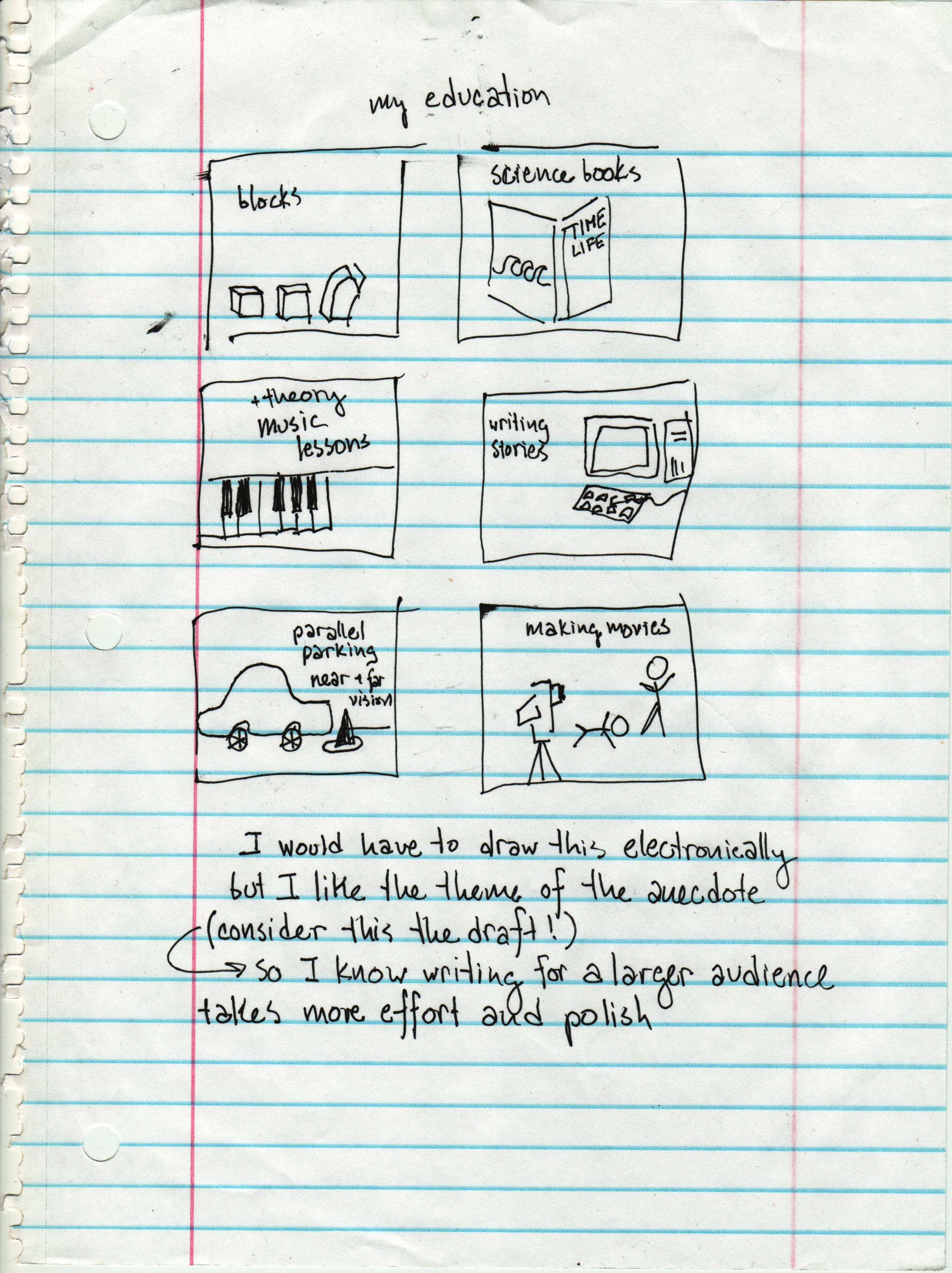
Tell the story of your education — for an audience of 100,000.

Here’s mine:
My Education

We then had folks share out and talk about how a large audience affected their work (hence my notes at the bottom.)

Next up, we gave people papers that were blank, save a set of concentric circles. The innermost circle was labeled “private,” and the space outside all of the circles was labeled “out there.”

This was your “work map.” Prompted by the question, “where does the work live?” participants were invited to label each ring, based on their environment — and then map out where different products live.

My Work Map

For me personally, the mapping helped me realize how permeable many of the different audiences are at SLA. Several of the zones that we think of as being SLA-specific are also part of larger networks, but we leverage them more to network with each other, not the outside world.

Once people completed their maps, they shared and discussed — and challenged each other to think about what they could “push out” to a larger audience, a ring farther out on their map.

What really made this part of the conversation — and the whole session, really — was the presence of the SLAMedia crew, plus a few students who use Figment on their own. They scattered themselves at every table where the “adults” were, and from the beginning it was clear that we could have walked in with no plan at all, and they would have carried the day.

Our students are comfortable sharing all kinds of work online — written, artistic, school-assigned, self-promoted, photography, video, personal, professional… and they speak well on navigating the process and protocol for each of these.

For most participants, I think talking with our kids was an eye-opener. One big take-away from the session for me was the reminder about how many schools and districts take a defensive stance towards ANY publishing of online work. One participant described how her school uses google apps — but that they’re turned off at the end of the day, so students can’t access them or any of the work saved in the programs. Other teachers described how schools create draconian acceptable use policies, where no names of photos of students can appear online.

This reminded me of an auxiliary benefit of amplifying student voice at SLA: not only does it empower the students involved, it shows the education world what can be done, reasonably and safely and well.

“Analysis Must Show Thought”

This post is me collecting my thoughts in preparation for the #Engchat discussion I will be helping out with on Monday, 2/13. We will we talking about teaching analysis skills — and not because I am an expert on the topic. Because, in looking for resources and suggestions, I browsed the Engchat vaults, and couldn’t find any chats around this theme.

My awesome #ux students do some analysis & synthesis on literary interactions

What I have noticed in my class is that analysis is something I tell kids to do a lot, but don’t necessary explain. Here’s some examples of what I say, usually to help with analysis in writing:

“Analysis comes after the context and the quote in your body paragraphs. And it should be the biggest part of each paragraph.”

(What, like a big cut of meat? That I can put on the scale for a grade?)

“Analysis should always justify your example, and explain how it relates to your thesis.”

“Don’t summarize, analyze.”

“You analysis should explain the how or the why behind something, not just take a position on a topic.”

What it all seems to boil down to, though, I stole from fellow SLA teacher Matt Kay:

“Analysis must show thought.”

Are you thinking? Are you thinking? Are you thinking?

(Quick, where’s my think-o-meter?)

So I’m interested in exploring all the little tips and tricks that can help massage students’ thinking. But most of all I am asking myself — how do we create a culture where that great analysis can happen in the first place?

Creative Commons photo via Flickr.

What Happens when Digital Learning Day is Every Day?

A typical Journalism class at SLA. Except I’m usually seated at the big table with everyone (really). Photo by Sam Lovett-Perkins.

When students at SLA hear about “digital learning” at other schools, sometimes they are patient… and sometimes, just sometimes, they roll their eyes.

They love that they belong to a community that’s on the cutting edge of technology integration in the classroom. They know the difference between moodle and drupal, about firewalls and bit torrents and advanced permissions. They have done more multimedia project work than most college students, and blogged way more than the average American.

But by now they also know that all of this tech savvy is not the key to their education. They will be the first to tell you that the laptops are not what make SLA tick, and are so over the hype of their fancy machines.

So, once you’re over the hype, what’s next?

We’re in our seventh year as a school, and a big theme now is sustainability. What works, and can keep working in the future? What doesn’t burn out our brains or our laptops? What will students still be interested and committed to after a few years or a few decades?

This focus on creating a sustainable system has carried over to the first-ever Journalism class at SLA. The goal from the beginning was to create a source for student-created media.

So we asked ourselves — what does our community need? And what will attract them?

With all that in mind, they came up with the name — SLAMedia. They picked the template. They wrote and revised the mission statement, and they manage and promote the site. They have a twitter feed, and a social media coordinator, and videos are forthcoming.

Student-led learning is nothing new. What makes this so much more real is the digital medium. The building blocks are aren’t blocks at all, they’re malleable. They can build what they want, tinker with the pieces. Unlike some more “traditional” high school journalism programs, they’re not creating in the shadow of the old-school newspaper template. They’re building exactly what they think SLA needs, and creating a venue versatile enough to support what they haven’t even thought of yet.

We’re now about four months into the project. For the first class of the New Year, we devoted a whole class to pipe dreams–no idea was too outlandish. They want so many different things! Field trips, and photo gallerys, and a better facebook presence, and more guest speakers, and oodles of schwag with our name printed on it.

In their personal reflections, though, they hit on one common theme — “I want to build something that will still be here after we’ve graduated.”

So on Digital Learning Day, what can you do that will last?

Talking about sex in literature.

Today was one of those rare days in English class — I walked in with at least one exact idea of what I wanted to talk about.

The tenth graders had just started reading “Their Eyes Were Watching God,” and I knew that at some point we were all going to turn to page 11 and give a good look at Janie under the pear tree.

To English majors this may seem like a yawn — I forgot about the passage myself until I was prepping a few years ago, and my roommate’s high school copy had the section underlined with the word “orgasm” scribbled in the margins. But now I make a point of hitting that page each time I teach the book.

Moreover, this is my fourth year working with this text, and it has been my consistent experience that I kind of have to lead my students by the hand to this passage, make them stand in front of it. Usually I read it out loud and then wait.

Light bulbs go off above maybe half of the class. A few smirk knowingly. Maybe a hand goes up, but often it goes back down in nervousness.

I have to say it first. “Have your minds turned to sex yet?”

Some students will be relieved. Others will still be puzzling over it, trying to fit the text into their schema for what a sexual scene is supposed to look like. Is the boy under the tree with her? Is Janie masturbating? What’s going on?

My students are not prudes. They get a comprehensive sex education in health class. Plus, they’re teens — it’s not like they can’t pick up on innuendo. But what I love about this passage is that it brings life to sexuality. It’s the pedagogical inverse of classic sex ed materials — cross-sections of genitalia and so on. Stop worrying for a moment about what sex is. What is it like? And why does it matter to our main character so much? What is the meaning of sex in life?

We can’t answer all of these questions, certainly not definitively. But the fact that we try, as a class — boys and girls together, no less — brings me a special teacher joy. That we can little sidetracked by embarrassed blushes and dumb jokes, but not totally derailed. That it’s pretty complicated, but we can reach for bigger ideas and deeper understandings. This is what I want them to know, about sex and literature both.

(And then, after ruminating on all this today, I came home and read about Sex and Society at Friends Select, a profile which will likely echo on the internet for a while. I had many thoughts after reading, but here’s the kicker: my old roommate’s book with the notes was from her freshman year in that teacher’s English class.)

How the technology can lead to the learning in ed-tech.

I’m currently sitting at a roundtable discussion with no participants.

The conference organizers asked me to lead a discussion around the topic of “Developing Student Community with Digital Tools” — but nobody showed up.

The other discussion in my room, however, is packed and stealing the chairs at my table.

Their topic? “iPads in the Classroom.”

You can imagine the logical places this post could go, right? I mean, in addition to some snarky, self-deprecating comments about how I’m at the prom without a date. SLA teachers could go blue in the face trying to convince people that it’s not about the tools, it’s about the learning. Put the education first.

But another interesting moment happened earlier in the day. One that helped broaden my thinking about this.

I was sitting in a session titled “Evolving Models of One-to-one.” Unlike SLA, these were all established schools who transitioned into using devices. After the panelists shared their different situations, a question came up about using machines for testing purposes.

The first panelists briefly mentioned all of the restrictive software they use on their laptops to make testing “secure” for students. But the second panelist replied with something to the effect of: “To be honest, having the tools has pushed us towards more authentic, project-based learning. We don’t test as much as we used to.”

Do I want people to do all that, even if they don’t have the tools? Of course. But if it takes the jolt of having the tools land in their lap — and maybe a little guidance from PD or a mentor — then I really don’t care. That iPad discussion had some basic “tips and tricks” comments. But it also teachers talking passionately about how their classrooms were being transformed.

So if people are thinking about the technology first, but that leads to thinking about the education — then we’re actually all sitting at the same table.

A Day in the Life: A couple Fridays at SLA

So, I mean for this to be a post exclusively about one Friday, but then I mixed up my days a bit and this ended up conflating a couple of weeks. Still, I think this gives you a sense of what can be special at our school, and not just at the end of the week.

1. My journalism elective sitting seminar style.

Journalism Awesome area journalist (and SLA aunt) Amy Quinn was kind enough to come and talk about her professional experiences. I’m just standing on a chair in the background so I can take this photo.

2. Tutoring at the LIt Lab

Lit LabPictured here are two Lit Lab tutors (both juniors) working with two students (both sophomores) who needed to have their essay drafts edited by an expert. This space is student-run, with minimal teacher supervision. It’s better that way. I was really just there to deliver lunch to my dad, who’s one in the back who doesn’t look like a teenager. He’s a retired professor who’s worked admissions, so he does intensive workshops with our seniors when they’re writing essays for their college apps.

3. Four PM Student Tech Team Visit

Tech FixI’m slogging through some vocab quizzes when five (!) students show up to fix my projector. Even more amazingly, they come back with it fixed after 5pm (when I’m still grading.) They were astonished to find me still in my room. “What are you still doing here?” They asked. “It’s 5pm on a Friday!!!”

On being tech-conscious.

A common question we get at SLA:

“How do you keep your kids from getting distracted by all that technology?”

My own thinking on this has evolved on this over the last few years. SLA has one of the most permissive policies on student possession and use of technology in a high school that I know of.

One thing that makes it so permissive is this: nothing is banned.

I know there is a ton of scientific research, plus scholarly commentary, plus a number of brick-headed adults who argue that access to technology is either “good” or “bad” for kids. I think that obfuscates the real issue, seeing as the technology is not going to go anywhere if somebody declares it “bad.” (I’ve been in schools where cell phones were theoretically banned — like confiscated-and-then-you-get-suspended banned — but nobody thought for a minute kids were leaving them at home. And boy was it a show when a phone went off in class.)

When people are dubious about how gadgets are allowed at SLA, I politely point out that there’s not much sense in banning these items when we give them laptops. It’s all in the mix, and students have to learn how to deal with the positive and negative influences of their tools.

That said, in the past few years I have made a concerted effort to nudge students in the right direction.

Take the beginning of class: my first year at SLA, I thought I was going with the tech-friendly flow by allowing kids to listen to music while they journaled on paper at the start of class. I then watched their preoccupation with their gadgets eat away at their focus. Students had to adjust their headphones. They had to pick their songs. If they were plugged into phones, they knew if they were getting texts. If they didn’t have a portable music player, they wanted to use their laptops — and then got sucked into their iTunes playlists — and all of a sudden journals were being ignored.

Year two I made a new policy: the beginning of class would be tech-free. Unless I explicitly said otherwise, all of your tech needed to be off and stowed away by the start of class, and journaling would be a 100% analog activity for the first 10 minutes.

When I introduce this policy, I make it clear to students that I’m not morally against their tech — I want to avoid any impression that I’m labeling this stuff “bad.” I make the point, however, that they need to be more aware about what they choose to fill their learning environment with, and that unconscious reliance on tech tools can be a problem. To drive it home for the 11th graders, I point out that the SAT is 4.5 hours long, and they need to do some “strength training” for that tech-free marathon.

The process is not without its eye-rolls or willful forgetting about headphones. But at its best, the policy invites conversation about their tech habits. And when everything starts put away, they make an active choice about what tools to use during class. Their use of tech has become more responsible, by leaps and bounds, since that first year.

To answer that first question I posed: Ideally, the students keep themselves from getting distracted. Here’s hoping that the conscious behavior sticks with them when they enter college.