Author Archives: lpahomov

Unknown's avatar

About lpahomov

English teacher at SLA, resident of Philadelphia.

Staff planning, or: how we build it ourselves.

SLA is still in the midst of its planning week, so I thought I would describe the structure that informs our faculty work groups.

With a tiny administration (principal, secretary, and a few killer assistants), planning and organizing has always been an all-hands-on-deck affair. Since we became a full-sized school, these tasks were formalized as committees, although sometimes we avoid that term for the less bureaucratic “working groups.” Each group has a couple of rotating leaders and a short list of members. Everybody is in at least one working group, and at least half of staff are committee chairs.

I know that many schools spend their professional development days “handing down” content — whether it’s curriculum, discipline plans, trust falls, or something else. I also know that this makes a lot of people want to poke their eyes out. In contrast, virtually all of our our PD is teacher-led — and these groups have already been meeting and planning in advance of presenting to the larger group.

A couple of examples from this week:

– The Attendance group shared their reflections on last year’s attendance issues, and presented a revised proposal for dealing with student lateness.

– The Diversity committee led a workshop on working styles.

– Our Technology Coordinator (who is also our art teacher) gave us a tour of some new interfaces we will be trying out this year, in addition to Moodle and our old favorites.

– The new Curriculum committee will be guiding some unit plan improvement workshops.

– The Advisory committee will be rolling out a new program designed to help beautify and care for school spaces.

I am not going to pretend that PD is always a joy for us — but there is a sense of investment that I haven’t experienced anywhere else. We pull from all kinds of plans and structures that exist elsewhere, but ultimately what we are creating is uniquely SLA. We’re not buying wholesale into a pre-packaged plan; if there’s something that’s not working so well, we can tinker and reorganize instead of looking for a complete replacement. And we have two hours a week of staff time all year long, so people have a chance keep talking.

I know that many schools are not built for this kind of collaboration — and as a result, teachers are never asked to own anything beyond their own classrooms. The policies are rigid, and if students are hitting their heads against them, tough.

Can this change? In Philadelphia, there’s recently been a move towards more autonomy at the high school level. A part of this is the financial reality of the district; other changes, like the move away from zero tolerance and rampant suspensions, is a conscious decision on the part of the board. Response from schools was positive. Hopefully people are willing to shoulder the extra responsibility in exchange for the results.

What’s your Teacher Temperament?

Like schools across Philadelphia and the country, SLA is in the midst of preparing for our first day of school. My twitter feed is full of anxiety about meeting new students, pictures of spiffy classrooms, and conversations about the first day.

One more thing to consider: are you ready to have a productive year with your fellow teachers?

I know that schools can be highly dysfunctional working environments — and that I’m lucky to work in a building that avoids most of the typical pitfalls. But we’re still a staff with very different working styles, and with so much energy going into our classrooms, we don’t always have the time or energy to understand each other. And with dozens of committees and two hours of staff planning time each week, working together well is even more vital than in a more typical top-down school.

To help us start this year on the right foot, the Diversity committee — which looks at all varieties of issues relating to both teachers and students — presented a one-hour activity today.

Teachers took a quick assessment survey (adapted from this page) and then identified themselves as belonging to one of the four temperaments. We then all had time to read through the following charts, and see what language applied to them:

The emphasis was not on feeling bound to one particular category, but getting some language to talk about your work style. Groups had plenty to chat about, including which qualities they clashed with.

This culminated in everybody answering the following questions on a public forum:

1. Your dominant categorie(s):

2. How do you work best? (probable strengths)

3. Where/when do you need to check yourself? (possible weaknesses)

4. What challenges you? What do you struggle or clash with? How do you deal?

5. What tips do you have for others to work well with you?

I obviously won’t be posting those replies here, but some great things happened as people had a chance to respond to each others’ posts and appreciate each other:

  • People identified shared goals or work styles that they hadn’t seen before.
  • People commented on how some perceived weaknesses can also be strengths, depending on the situation.
  • The value of having a diversity of interesting and working styles became clearer — people complimented others for excelling at what they themselves ignore or don’t do well at, even when that difference might lead to clashes.

When I was designing this activity, I was a little bit nervous that it could turn into a gripe fest, with people focusing more on the weaknesses of others than their own. Plus I have zero training in personality assessment. But everybody turned a decent critical eye towards themselves, with the goal of self-improvement. Hopefully the awareness now will help prevent frustration later. I like to think that we were modeling a good process for our students.


#Engchat Reflection: Icebreakers vs. Foundations

One of the things I both love and hate about Engchat is how quickly it flies by! At the end of a session my brain is stuffed with ideas. Here are my thoughts on today’s chat, sorted out:

It goes without saying that the first days of class set the tone for the year. Whatever you value most comes through loud and clear.

Of course, the first days are *also* full of some superficial-but-necessary administrative tasks. There are schedules to confirm, and policies and procedures to introduce, and forms that need to be signed, plus a lot of names to learn.

Once wise piece of advice I’ve gotten at SLA is to never let the administrative stuff crowd out the soul of your first day(s). One way to avoid this is to make space for a purely creative activity, be it visual, verbal, or kinetic.

These days, I’m also thinking about how to turn those administrative tasks into something that also impart deeper meaning, or provide an opportunity to build community. Here are some upgrades I have made in the last few years, and what I hope they communicate:

  • To learn names, I ask students to “tell the story behind your name.” You get great biographical details as well as some hooks to remember the name. I want their whole story, not just the surface details. I’ve done this in a private survey, but it could also be a group activity, or something that gets drawn on a name card.
  • To review policies and procedures, I give kids time to read it, and then have them pair off for a “pop quiz” where I ask them theoretical questions about their conduct in the class — things like “What happens if…” or “If I forget my homework…” At the end, I reveal that this quiz was NOT for credit. Why? Because I care about the learning, not the grades. Sometimes we ceremoniously rip up the little papers.
  • I try to put off any tasks are just plain grunt work, like setting up Google Docs or other online accounts. The boring stuff gets bottom billing.

Here are some new (to me) things I am thinking about for this year:

  • Via @sriii2000 – Sharing some of my own academic hardships and failures, before asking them to share and reflect on their own. Failure should be embraced so we can learn from it.
  • Asking students to brainstorm what a successful classroom looks like — we already have school-wide guidelines, but examples of what they know should happen. Students don’t have to be told what makes a classroom work.

The last piece is making sure that these points of emphasis continue on through the school year. My one gripe with “icebreakers” is that they can be fluff when you could have substance. Or worse yet, they are substantive, but then nothing fun or community-building like that happens again, ever. I try to make sure every activity is something that could be repeated for a cumulative effect, or collects info that can be revisited by me. It’s not so much the icebreaker as it is the underwater foundations for our class structure.

This post was inspired in part by John T. Spencer’s post on “Hidden curriculum.” Looking forward to composing my own list soon.

Building a home in the real world.

At SLA, like at many schools, we emphasize the importance of doing things in “the real world.” If at all possible, projects are designed to be shared publicly, and also to make sense to the general public — not just to the people who read the instructions.

Sometimes, this means we’re posting public art next to the school. Sometimes we’re planting a community garden. Students apply to and speak at conferences, travel around the world on service trips, and generally feel connected with what’s going on beyond the school’s walls.

A bit tricker, though, is our online content. The easiest way to share is to post on our class blogs — and we do that plenty. I love reading, viewing, and listening to work posted there, but the emphasis is often more on a student’s individual portfolio than the collective effort of a project or a class.

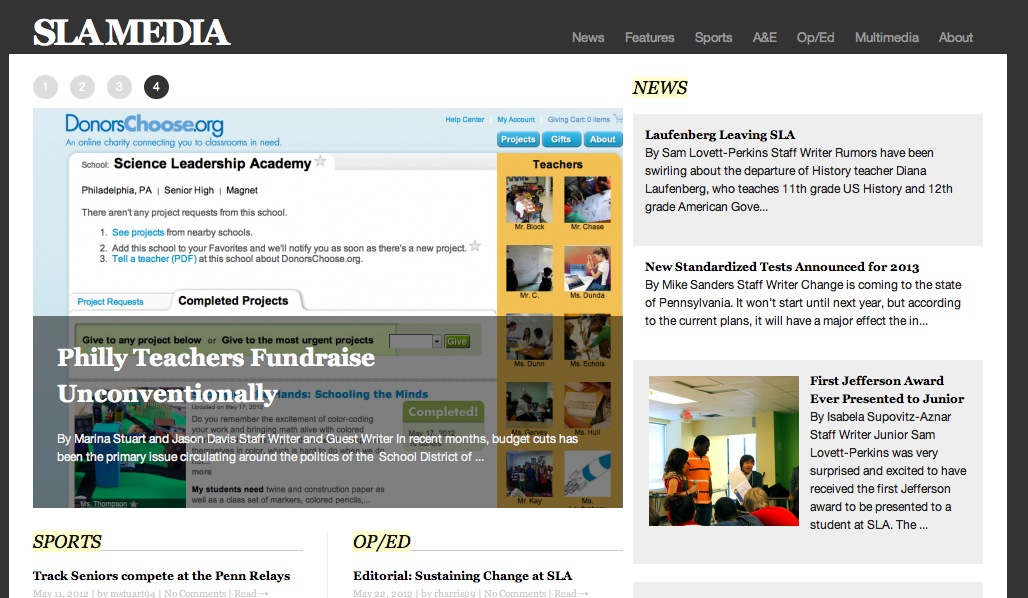
It only recently occurred to me that we could build our own spaces for those projects that benefitted from a customized home. After a week of pouring over different designs, our first Journalism class picked the template and the content areas that would  become SLAMedia.org:

Going this route made me more aware of other student-centric sites in the area, like UPenn’s The Blacktop and Mighty Writers’ forthcoming Mighty Post. When media was print-only, students were relegated to the annual newspaper poetry contest or maybe a letter to the editor. There are a few outposts for printing student writing at the “professional” level — The Concord Review  and The National High School Journal of Science come to mind — but those are few and far between.

Now that we’re online, professional venues still don’t make much room for student writing* — but they’re conveniently no longer the gatekeepers. We can set up our own showcases, not just in emulation of professional organizations but at their level.

With all this in mind, fellow 11th Grade English Teacher Meenoo Rami and I have just established The 2Fer Quarterly. 

2Fers, in brief, are short analytical essays that SLA juniors write every two weeks — on any topic they choose. If you want to know more about how to teach them, go here. But if you’d just like to get to the good stuff, watch this space in the next couple of months:


Students will be invited to post 2Fers — not every essay, but the ones they think are best — in a venue that, quite simply, is designed to be classy. Expect independent ideas and commentary on everything under the sun — science, humanities, media, politics, technology, and hopefully some criticism of 2Fer writing itself.

Are we going to get the same traffic as Slate or Salon? Goodness, no. But we know there’s an audience out there for us, and we hope that you’ll be a part of the process and the conversation.

*A notable exception is The Huffington Post, which does feature columnists who are at the college and high school level — although usually only for education-related topics.


Summer Institute at SLA.

Pic courtesy of Meenoo Rami’s Twitter feed.

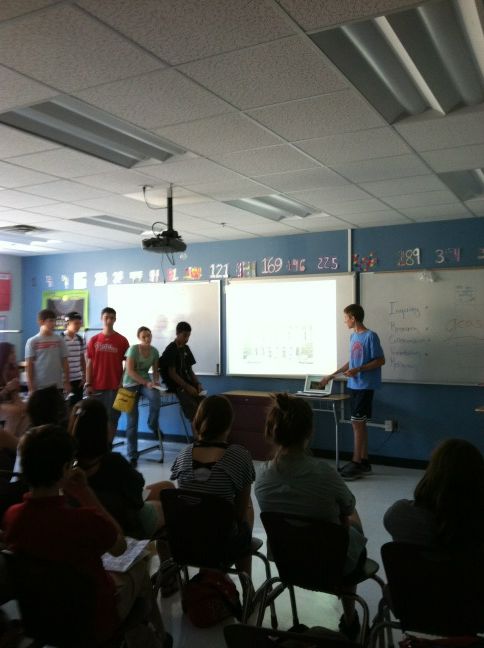
Today wraps up SLA’s annual Summer Institute, where our incoming freshmen spend a few days getting to know each other and the basics of how SLA works. They go out in Expedition Groups to as questions and explore sites near the school, and then have to collaborate on a presentation for their fellow freshmen on the last day. (Sound like SLA’s core values? Good, you’ve been paying attention.)

Here are some reasons the week is special, for them and for me:

– Freshmen are still adorably astonished at how friendly, relaxed, and empowering the environment is here. Upperclassmen volunteer in droves, teachers play roles in their skits, and laughter is an explicit goal.

– We help them unlearn some of their ingrained “schooliness” — when we explore the city, there is no “right” answer; the goal is ask questions that lead somewhere interesting.

– They begin to rely on each other, not the teacher. While working on their presentations, freshmen would sometimes leave their groups and come to me seeking approval on a idea. I would send them right back.

– They bring us new energy. This is my fifth year teaching full-time, and also my fifth year at SLA. Last year, my first advisory group graduated, and the door is open for some “I’ve seen it all before” mentality. That is the opposite of true. My new kids are a whole new world to discover, and this week I had time to learn that they keep chickens, and hate candy, and speak Urdu at home. We’ll drown in paperwork next week, but for now we just have each other.

What do you do to help freshmen feel comfortable? How do you avoid making it all paperwork and procedure?

Taking Time To Think

Writing in Berlin

Ok, class report: What did you do during your summer vacation?

As evidenced in the photo above, I wrote a fair deal. I produced a resource for NWP’s Digital Is about turning traditional essays into one-minute videos, my first attempt at a scholarly article (fingers crossed), and a proposal for a book chapter (fingers crossed, now both hands are busy).

I also continued to not post to this blog for several months. Last year I had some great spurts of posting — and those posts reached people in the way that I had hoped — but there were also long, long periods of drought. I could never find the right spot in my week to make writing a routine, and the magical moments of inspiration did not happen frequently enough, or at least did not translate into blog posts. And the summer reminded me that, for the big stuff, writing always takes me a few days.

What did you do during your break? How did you refine your practice?

I also spent a whole month in Berlin, dusting off my German — can you tell by that foreign-looking window in the picture?

Making Tech Meaningful.

I had the pleasure of speaking at the VAIS Technology Conference last weekend, on the theme of  “Making Tech Meaningful” — a phrase and focus that came to me at least year’s EdCampPhilly, in response to all of the gadget-y sessions that were popping up on that day’s schedule.

After I talked at them for about 30 minutes, most of the (many) questions focused on SLA’s culture and approach towards technology use towards social media.

Many of the people in the crowd were the tech coordinators or IT specialists and their schools, and their questions often reflected a culture of restriction vs. responsibility when it comes to the role technology plays with our students. Sometimes I forget that questions like “Don’t the laptops distract them?” or “What if they download pornography?” are the first things coming from worried administrators.

After the talk, many people came and said I had given them a lot to think about. After lunch, one woman came and whispered to me: “I agree with you! We should be teaching responsible use, not restricting them.”

“You don’t have to whisper here!” I replied. “Just say it!”

Test prep, part 4: the little guys.

You might expect that the phrase “the little guys” to be some kind of diminutive for those humble, overlooked students who just need more attention when it comes to test prep.

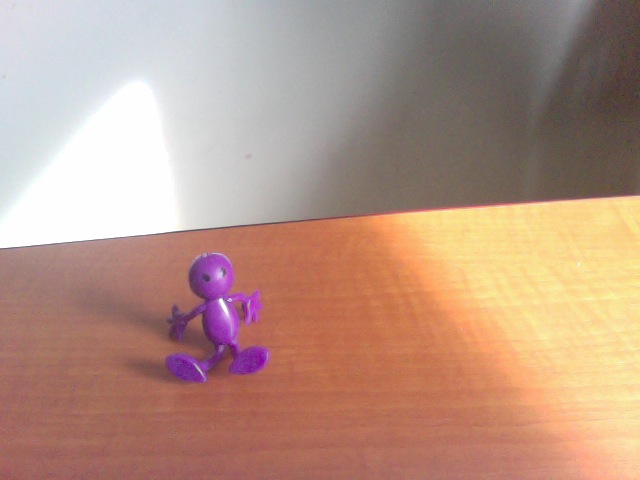
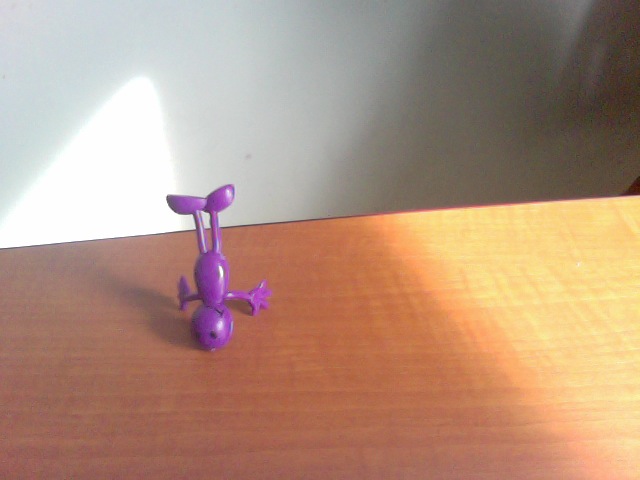
In fact, “the little guys” is what we’re calling the small plastic figures I gave my students who are PSSA testing next week.

Purple little guy.

Once the news broke that there was no way I would be proctoring tests with my own students, I wanted a way to be in the room with them. A few google searches later and I had these little tokens for a few dollars a dozen.

Call it a totem, or a good luck charm, or an avatar — although I didn’t use any of these phrases when they first got distributed. I handed them out when we were working on a practice test — kids picked the color they wanted, purple’s just one iteration — and asked them to think about what their little guy needed to say to them when I’m not there in the room.

You are unique snowflake?

Slow down?

Wake up?

Write more?

We agreed that frustrations could be taken out on the little guys (provided that it doesn’t get noisy or do any lasting damage.) Plus their joints bend, so you can have them be a little active for you when you’re stuck in your seat.

Turns out the little guys are not so good at standing up, but they do sit. They can hug each other pretty well. And they can stand on their heads.

Look ma!

Look ma!

I will have you know, this official instructional method is Testing-Coordinator-Approved. And in a week that has been a little low on excitement, my 11th graders are feeling good about the little guys. A little island of play in a big sea of multiple choice bubbles.

Test prep, part 3: pick the right language.

The last big idea I want to share about test prep at SLA does not relate to a specific lesson plan, but to a more general approach I take when working through test prep.

A few weeks ago I got a strong response in class when I told them, “I don’t love that this stuff exists, but I love that I get to show you how it works.” Along those lines there is a lot of language that allows me to do a silly dance around the testing material, the kind which pokes a bit of fun but also makes you perk up and pay attention. Tactics include, but are not limited to:

– Talking about “killing off” answers during process of elimination made one student comment that she felt like a “test assassin” — and the class ran with it. Alternately, making them “test pirates” and having them throw wrong answer overboard.

– Reading sample questions and answer possibilities in my extra-special game show television announcer voice.

– When students are analyzing question types and building their own, describing the process as “getting into the mind of the criminal,” like a detective. “Don’t think about the right answer! How would the test writer come up with the best answer?”

The flip side of this language is how I address the students themselves. (Thanks to Bud for pushing my thinking on how to explain this.)

A few years ago, it was actually an old roommate who busted out the line “you are a unique snowflake!” when I was talking about something or related to motivation and education.

On a whim, I busted it out during my first year of PSSA proctoring at SLA. It stuck immediately. The kids were writing it on the dry erase board at the end of each session by the time we were done.

My full line has now become, “I love you! You are a unique snowflake.”

I use this as a necessary antidote to any moment that threatens to destroy a student’s confidence, stamina, or general interest level. It gets mentioned in class before testing, tacked on to the end of instructions during exams, and is also my response any time a student asks me a substantive question during the test which (they know) I can’t answer.  It’s the buoy that kids can latch onto as their energy wanes, or the salve I can offer them when they frustration is about to bubble over.

There’s a longer post in me about the words “I love you” in school, and how important they are. In this particular situation, it’s the strongest weapon I have against an infrastructure that, intentionally or unintentionally, has greatly restricted my ability to care for my students.

So, to answer Bud’s question, if I can’t find a way to put care in the infrastructure, I give my students love in the face of the system.


Test prep, part 2: build your own version.

Once we take apart the machine — and apply the language to a couple of practice tests and sample questions, done all-class, and in pairs, and independently — the next phase is to write their OWN multiple-choice reading exam.

I give them a detailed template where the prompts look something like this:

Required: ONE “Main Idea” question

How to come up with the best answer: Read the entire article, and come up with a single sentence that explains the opinion of the author and/or the main person being profiled in the story.

How to come up with your other three answers: Create statements that mention the same topic, or focus on a specific part of the essay, but don’t summarize the entire passage.

Write in your “Main Idea” question and answers here:

Q:

(a)

(b)

(c)

(d)

We started by working in pairs and all reading the first few pages of the same essay. I picked something that has consistently proven high interest: The Inner City Prep School Experience.

Because my students have consistent internet access, I could have them search for their own essays on NYTimes.com – I specifically limited them to longer articles from the Sunday Magazine, which were in-depth enough to excerpt the first 1500 words or so and have it be similar (or more advanced) than the pieces in the PSSA. Giving them freedom to browse and choose an article that interested them was key, but it would be easy to present them with a selection of articles pre-printed in class.

They build all of the different question types: Main Idea, Drawing Inferences, Context Meaning (aka vocab), and so on. Some of the observations they quickly make:

– Writing the answers is a lot harder than writing the questions.

– The right answer often comes out as the longest; you need to extend the others so that they match in length, and also have some common threads.

– There are rarely 100% “throw away” answers that having nothing to do with the reading; good “red herring” questions incorporate some actual details from the article, but twist them around or just aren’t the right answers.

Once we’re done, we print and take each other’s exams. The peer review is popular because the reviewer tried to take the exam as well as rate it, and the author got to see how easy/difficult their exam was.

Relevant handouts:

Build Your Own Assessment Template

Peer Review worksheet