How can you go PBL? With Inquiry to Action.

This evening, I will be attending Teacher Action Group’s Kick-off event for their 2013 Inquiry to Action Groups. Last year, I participated in an ItAG called “Context for Change,” and one of my big discoveries from those sessions was that I would do well to share content from SLA with the outside world. (Hello, blog.)

This year, I’m thrilled to facilitate an ItAG about project-based learning. The group already has a clear “action” in mind — design and implement a project-based unit in your classroom — but that will obviously look different for each person. Here are the all goals for the group:

  • Create a Project-Based Learning unit for your classroom
  • Gain a working knowledge of Understanding By Design lesson planning
  • Strategize on how to bring PBL to your learning environment
  • Collaborate and network with like-minded teachers
  • Develop a session for the 2013 Teacher Action Group Curriculum Fair

Going into this process, the big thing I am thinking about is how to meet educators where they are at — both in terms of individual knowledge and the settings in which they work. One misguided response we get to our work at SLA is “you could only get away with that here” — which couldn’t be any further from the truth! I am excited to help educators from around the city play with PBL and make it work for them.

The group will be meeting for six weeks at SLA. If you’re in Philadelphia, there’s still time to register for and attend the kick-off meeting. For those who can’t make it, due to scheduling or geography, I am going to do my best to blog our group’s materials and activities here. If you plan on following along at home, please let me know in the comments!

As a preview of what we’ll be up to, here’s a short video that introduces the basic tenets of PBL — chipper, but informative.

Rubrics Across Disciplines at SLA.

My last post included the rubric for the Independent Reading Project — but there have been some requests for an overall discussion of rubrics at SLA.

This is what our online school handbook says about our rubric:

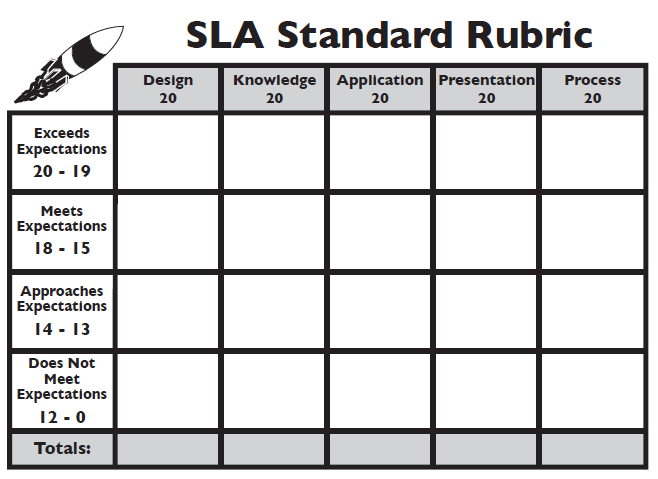
Students at SLA are assessed through a variety of means with a focus on project-based learning and our five core values of inquiry, research, collaboration, presentation, and reflection. Our students do not take the School District of Philadelphia benchmark exams; rather, they complete projects in every subject that are assessed based on the SLA rubric (see below). The descriptions in the empty boxes are filled in according to the subject and project nature.

And here’s the rubric outline, as it appears on posters throughout the school:

SLA Standard Rubric


There are a thousand directions I could go in discussion of this rubric — but I want to focus on formatting, and how that influences student understanding.

The categories ensure that teachers provide more than just a checklist for students. Specific items or tasks can be listed in each section of the rubric, but the categories ensure there is a deeper meaning to what’s being assessed, instead of just checking that everything is in place.

Sometimes, teachers follow the format completely. Take this rubric for a calculus benchmark, courtesy of Math Teacher Brad Latimer. His description of the project:

 For the project, students had to research applications of various types of derivative functions, and then design a webpage demonstrating derivative applications. Their page had to include original problems and solutions for each type of derivative function, as well as analysis of what each derivative function represents.

The languages shifts for each level of expectations, and he also included some clarification as to what will be graded in each category. (In my own experience, the difference between “design” and “presentation” can get fuzzy when you are writing these — here it is crystal clear.)

Calculus Second Quarter Benchmark                    Name: ________________________

Exceeds Expectations

20 – 19

Meet Expectations

18 – 16

Approaches Expectations

15 – 13

Does NOT

Meet Expectations

12 – 0

OVERALL

SCORE

Design

Design of website and original problems

Website flawlessly illustrates applications of derivative functions and demonstrates how to differentiate various types of specific functions; all 8 topics are included. website clearly illustrates applications of derivative functions and demonstrates how to differentiate various types of specific functions; 5 topics are covered and meet expectations. website mostly illustrates applications of derivative functions and demonstrates how to differentiate various types of specific functions; 1 topic is missing or not  covered; website approaches expectations. website does not demonstrate applications of derivative functions or how to differentiate types of functions; multiple topics are missing or incomplete.  
Knowledge

Using different rules and techniques to find derivative functions

All derivative functions are found flawlessly for all 8 types of functions; solutions and uses of different techniques exceed expectations (simplified completely). All derivative functions are found without error for 5 types of functions; solutions and uses of different techniques meet expectations. Most derivative functions are found for 4 types of functions; project contains 1-2 errors; solutions and uses of different techniques approach expectations. Project displays weak and minimal knowledge of derivative functions; derivative functions are missing, incomplete, or contain many errors.  
Application

Application of different techniques to find derivative functions

Flawless analysis of derivative functions for all 8 types of functions, including the process of finding the derivative and the meaning of the derivative for the specific problem. Accurate analysis of derivative functions for 5 types of functions, including the process of finding the derivative and the meaning of the derivative. Somewhat flawed analysis of derivative functions for 4 types of functions, including the process of finding the derivative and the meaning of the derivative. Explanations and/or analysis have one/two mistakes or one type of function is not included. Highly flawed or incomplete analysis of types of functions; techniques for finding derivatives are missing or incomplete, and not analyzed at all.  
Process

Completion of project

All parts of the project are completed on time and beyond the necessary requirements. All parts of the project are completed on time and meet the necessary requirements. Most parts of the project are completed on time and meet the necessary requirements. Many parts of the project were missing or incomplete.  
Presentation

Presentation of website

website is superbly written and polished; methods to find derivative functions are flawlessly demonstrated and presented; all aspects of the website exceed expectations. website is well constructed and polished; methods to find derivative functions are demonstrated and presented; all aspects of the website meet expectations. website is pretty well constructed with a few mistakes; methods to find derivative functions are demonstrated and presented with 1-2 mistakes/omissions; most aspects of the website meet expectations. website is not well composed with several mistakes; methods to find derivative functions are not demonstrated or presented;  almost all aspects of the website do not meet expectations.  


As with all templates, some tinkering does occur. One of the big things that teachers often change is not filling out the full rubric. (There’s debate as to whether you really need to describe what “does not meet expectations” after you’ve given clear instructions about what does.)

Here’s another example from Latimer’s classroom, where he chose only to detail the “process” section for every category.

For the project, students were partnered up, and each pair was given a different investment and credit situation. They then had to research five different options (bank, lenders, credit cards, etc) to deal with each situation. The final product was a detailed research paper which made a recommendation on the best option for their specific situation, and included mathematical justification (using exponential functions and compound interest formulas).

Algebra 2: Quarter 4 Benchmark Rubric- Applications of Exponential Functions

Name: ________________________________ Band: _____________  Partner: ____________

Exceeds Expectations

20 – 19

Meet Expectations

18 – 16

Approaches Expectations

15 – 13

Does NOT

Meet Expectations

12 – 0


SCORE

Design

Design of paper

  Paper is well designed; all required components/sections are complete; 5 different savings and 5 different credit options are covered, and all calculations and citations are included; individual work is also included.      
Knowledge

Knowledge of key concepts involving exponential growth and compound interest

  All mathematical calculations are correct and meet expectations for 5 investment and 5 credit options.      
Application

Application of knowledge of exponential functions

  Analysis section of paper clearly and accurately applies knowledge of exponential functions to specific situations; conclusions for your situations are clearly explained and justified using mathematics.      
Process

Project is complete and submitted on time; Use of in-class work periods


All parts of the project are completed on time and beyond the necessary requirements; excellent use of all in-class work periods All parts of the project are completed on time and meet the necessary requirements; all in-class work periods are used effectively Most parts of the project are completed on time and meet the necessary requirements; effective use of most in-class work periods Many parts of the project were missing or incomplete; ineffective use of in-class work periods.  
Presentation

Presentation of paper

  Final paper is polished and professional in appearance. There are no typos, and all required sections of the paper are included.      

I think it’s relevant that this is a 4th quarter project — at this point it should be clear to many students what the expectations of the class are, and to mentally fill out the details of what exceeds, and what does not meet, the expectations of the class.

Many thanks to Brad Latimer for sharing this content and making this post possible. Let me know if there are other disciplines you would like to see materials from.

Independent Reading: The Rubric.

There was a lot of interest at EduCon about our grading rubrics at SLA, so I’m putting out the one I wrote for the Personal Reading History.

The Friday before the project was due, students completed a peer editing routine similar to the one that they do for 2Fer Essays. (This was also EduCon Friday, so if you visited on that day, chances are good this is what you saw.) The peer editing sheet had the following questions, with room for written comments as well. I often use this blend of on-screen and on-paper notes, especially when there is no natural way to leave comments in Prezi.

PEER EDIT CHECKLIST          Peer Editor: ___________  Creator: _____________

Does the Prezi include the student’s name in the title or first slide?    Y   /   N

How many items for their Reading History do they have?  _____________ Are they numbered?  Y   /  N

Does the Reading History do more than just share details? Does it share why these scenes are important for understanding the student’s approach towards reading?

Do they have a basic description / intro for their book?   Y  /   N

Does the Prezi include the book’s title AND author?    Y   /   N

How many items for their Annotations do they have? _______________   Are they numbered?   Y  /   N

Is there a good variety of annotations? Does it share why these annotations are KEY to understanding the book, and the larger themes and ideas behind it?

Do they have two clear items of reflection at the end?   Y   /   N

Does this reflection explain both what they gained from doing the annotations AND examining their personal reading history? Does it connect the two in some way?

Presentation – is the project free of spelling, punctuation, sentence structure issues? Note SPECIFIC problems here, because you can’t mark Prezi with a red pen:

Design- Does the Prezi have a unified theme? Does it flow nicely? Does the path make sense? Note specific moments (by number) that have problems, and explain:


The rubric was published on the back of this peer editing sheet — and we discussed it once the rounds of peer editing and finished, and before revision work began.

The final product was then presented in class on Monday — students did a gallery-style presentation, where they loaded their Prezis on their own computers, and then rotated around the room in 10-minute cycles. They left comments for each other in the rubric section, which was on the back of their peer editing sheet. I left my comments after the student comments, and sometimes in dialogue with what was already written: I agree! Or, I disagree! Each category is out of twenty points, which I scribble as small as possible in the corner of each section.

Design – The flow of the Prezi is both logical and engaging, and incorporates both text and visuals. There is a unified feel to the project. Student comments:


Pahomov:
Knowledge

The project reflects a deep understanding of the student’s personal reading history as well as the many ways a book can be annotated and analyzed. The content of the project does much more than just scratch the surface of these topics.


Student comments:


Pahomov:
Application

Different forms of annotation are applied to the book, and the annotations include commentary about why these details are significant. Closing reflection ties the commentary about the book together.

Student comments:


Pahomov
Presentation

Project is well-edited and is free of errors in spelling, punctuation, sentence structure, etc. Images or other media included are of high quality.

Student comments:


Pahomov:
Process

All points of the project were completed on time and beyond the basic requirements.

Pahomov only:

Reading History:       / 5          Annotations:         / 5

Final Product:        / 10


Link to Reading History Peer Editing form and Rubric 


Independent Reading: Process and Product

A snippet from the assignment write-up:

Reading is something we do all the time — so much so, that we rarely really think about how and why we read.

Your task with this benchmark is to take a close look at your reading — the personal history behind your readership, and also your skills as reader today.

Notice what you read and why those were the choices you made.

We spent about one week just on the building blocks of this project — the scenes from their history, and the annotations for their current book. Once those were complete, it was time to insert those into Prezi.

When we started the work, I did a snapshot poll of the class — and it turned out that, like me, the majority of them had not used the program before. This presented us with a classic situation in project-based learning — integrating content and skills.

At SLA, we try out many different mediums for visualization of projects, and it always takes some time to learn the ropes of a new program. If you look at your classroom strictly as a conveyer of content, this process gums up the works: students have to tinker, and discover, and teach each other, and focus on something other than the book at hand.

Luckily, we don’t believe that at SLA. Presentation is one of our five core values — so turning the raw materials into a final product that was both easy to follow and pleasing to the eye, with a mix of visuals and text.

To better aid the students, I built partial models of the project. I say “models,” because the first one just had me dragging and dropping without much of a plan. Once I had learned a few things, I developed a second one — and then showed both in class, and summarized my findings in the last slide of the “improved” Prezi:

We then spent several full class periods in “benchmark work mode,” which would include mini-lessons as needed for particular tips and tricks (“does everybody know how to rotate a frame?”) I was also available to scan pages of books students wanted to include, while others used their in-screen cameras.

The best projects were ones where students were already confident in their content, and students could develop a unified vision of how annotations grow out of the text on a page. Here are a few examples.

Roberto Abazoski – “Every Day” by David Levithan

Jalisa Smith – “Lies My Teacher Told Me” by James Loewen

Roger Bracy – “Eleanor and Park” by Rainbow Rowell

Independent Reading: Personal History Project

If you visited my classroom on the Friday of EduCon, you saw students working on the final version of this project — aka peer editing their Prezis.

That was the tail end of a two-phase project, where students first had to write detailed annotations of their current independent reading book, as well as a few scenes of their “reading history.” Then, we used Prezi, a dynamic presentation program, to style the material.

The goal was to link together some of the close reading they were already doing in their weekly reading trackers, as well as tap into their own triumphs and struggles with reading over time.

Posted below is the (lengthy) project instructions. Students were not responsible for every prompt — the idea was to give them many springboards for their own thinking. I will post some final projects and reflections on the process in my next post.

Personal Reading HIstory

Reading is something we do all the time — so much so, that we rarely really think about how and why we read.

Your task with this benchmark is to take a close look at your reading — the personal history behind your readership, and also your skills as reader today.

Notice what you read and why those were the choices you made.

Here are the pieces to the benchmark:

1. Three Scenes from your Personal Reading History

First, it is your job to go into the past and share three scenes from your development as a reader. These stories can be stories of triumph or struggle–and should probably be some combination of both. Here are some prompts to help you identify important scenes from your life:

– When do you first remember reading? How did it feel?
– What’s the first book you read? Why was that important to you?
– How is reading treated in your house? Does your approach to reading “match” what your family does?
– How is reading treated by your friends? Does your approach to reading “match” what they do?
– How do you feel about reading in school? Is there a teacher who was made reading amazing, or awful? How did they do that?
– How do you feel about choosing a book vs. assigned reading? How have these options influenced your reading in school vs. in your free time?
– How do you feel compared to other readers? (As a teacher, I don’t want you to compare yourself to anybody, but I know this happens.)
– Have you ever been labeled a “struggling” reader? How about an “advanced” reader? What did this do to your reading?
– What’s the last book that you read that you enjoyed? What’s been going on with your reading since then?
– What do you read in secret? Why has that been a secret (until now)?
– Any other key moments where you saw a development or shift in your mindset about reading.

2. Eight Annotations for your Independent Reading Book

Next, it is your job to illustrate your current skills as a reader by describing what your brain does while you read. Pick a few pages from a book you’ve read during the Independent Reading Unit, and create written annotations in eight different ways. Annotations could be as short as a couple of sentences, or as long as a couple of paragraphs, or even a drawing or visual annotation — it depends on what you’re writing about. It just needs to be thorough, and that means explaining WHY this annotation is relevant to understanding the book.

Here’s a PARTIAL list of what you could annotate:

o   Identify and apply the meaning of new vocabulary.
What does that new word mean, how did you figure it out? Why is this word relevant to the book?

o   Identify and apply word recognition skills
What unusual word did you already know, and how did you know it? Why is this  word relevant to the book?

o   Make inferences and conclusions about what’s happening in the text
Refer to the text on the page, previous parts of the book, and your own knowledge. How do you know what you know?

o   Identify and explain main ideas and relevant details
What’s going on in the book? Why does it matter?

o   Identify, describe, and analyze genre of text
What qualifies this book as historical fiction, fantasy, mystery, politics, how-to, etc.? Has to be more than just the title!

o   Interpret, compare, describe, analyze, and evaluate components of fiction and literary nonfiction For example: Character, Setting, Plot, Theme, Tone, Symbol, Mood, Symbolism. More types available on the literary devices website.

o   Make connections between texts.

What books, movies, TV shows, other texts relate to this book? How does that enrich your understanding?

o   Identify, interpret, describe, and analyze figurative language and literary structures in fiction and nonfiction: For Example: Personification, Simile, Metaphor, Hyperbole, Satire, Imagery, Foreshadow, Flashback, Irony.  More types available on the literary devices website.

o   Identify, interpret, describe, and analyze the point of view and effectiveness of the point of view used in the text.

First, second, or third person? Maybe a combination of both? How do you know, and how does it influence the reader?

o   Interpret, describe, and analyze the characteristics and uses of facts and opinions in the text.

If it’s fictional, you can analyze the feelings and opinions of the characters. If it’s non-fiction, focus on the text itself and what it’s presenting.

o   Identify, compare, explain, interpret, describe, and analyze how text organization influences the text.

Look at the structure of the chapters, each section, different categories, or other organizational methods. How do they help the reader understand what’s going on?

3. Concluding Reflection

Lastly, you will need some closing reflection on everything you have done. By doing this project, what deep understandings have you gained about your attitude and approach towards reading? What did you learn that you didn’t know before? And what skills do you need to work on in the future? Where do you think our reading history is going?
EduCon Resources: Standards Based Grading for Social Studies.

There was a lot of interest in my last post about Standards Based Grading and Reporting at SLA, so I thought I would share more from that session from different disciplines.

I should also mention that, while these standards were developed at SLA as a kind of pre-emptive response to Common Core, they were more heavily based on the written standards of our respective professional organizations than CCSS. English teachers, for example, pulled from the NCTE standards.

Additionally, we are in our second year of implementing standards-based systems at the school, and the process is definitely still being tinkered with (as all good educational systems are). Below are the five categories that our history discipline uses in their classes. Note that it overlaps two categories with English — “Discussion” and “Research.” Science uses “Research” as well. Should we streamline our language across disciplines? Or maybe make them less similar, to emphasize the difference in each version of the skill? Is it a problem that “research” is also one of our school’s core values, but other values on that list aren’t included as categories for standards?

Just a few questions to get your brain started. I feel very lucky to be in an educational setting where we get to tackle these ideas. Without any further ado:

History Standards

The SLA History department focuses on five main areas for the standards at each grade level: Sources, Research, Perspective, Discussion and Content.  Throughout the four years at SLA the skills gained in one grade spiral forward to the next course.  By graduation, the goal is for students to develop the ability to effectively analyze primary source documents, research independently, express the impact of perspective and bias in history, meaningfully contribute to classroom discussions, and evaluate the connections between the modern world and history.  Assessments for this work are embedded within the day-to-day coursework, as well as within the quarterly benchmarks.

Grade 9 Grade 10 Grade 11 Grade 12
Sources Student can analyze a variety of source documents including visual representations of information. Same  Same  Same 
Research


Student is making progress in producing independent research-based projects. Student can construct independent research-based projects. Student can independently locate a variety of sources to effectively incorporate into research-based projects. Student can independently locate a variety of sources to effectively incorporate into research-based projects.
Perspective Student seeks to understand and fairly present the ideas of others, even when they disagree with the point(s) being made. Student can begin to express the impact of perspective/bias in history.  Student can express the impact of perspective/bias in history.  Student can express the impact of perspective/bias in evaluating political systems. 
Discussion Student consistently presents his/her own idea(s) in a constructive and useful manner.  In daily class activities, student can represent their ideas (all class discussion, online forums, small group, etc.) on history using sources to back up their contentions. Same  Same 
Content Student uses the content of the class to explore and expand their understanding of the world.  Student uses the class content as a medium to build understandings and make connections between both various systems and the past and present. Student can evaluate connections between the modern world and American History.  Student can evaluate connections between the modern world and the basic elements of political theory. 

EduCon Resources: Creating The Ethic of Care.

Awesome notes courtesy of hellohomeroom.

Awesome notes courtesy of hellohomeroom.

The second session I was involved with involved significant less planning — but also somewhat more heart — than Standards Based Grading and Reporting.

Lehmann, Pia and I — and Mark Bey, and alumnus Mike Dea, and a smattering of SLA freshmen who all chose to be in the room just because — took folks on a meandering but meaningful tour through how care works in our building, and how we “care for” instead of just “caring about.”

Here are the prompts we used for the discussion:

  • What is the difference between care about and care for?
  • How can you (help teachers) make that transformation?
  • What are the challenges of this switch?
  • What are the tensions between caring for the adults and the children in the building?
  • How do you schedule care?
  • How can care be built into every structure and system that you have?

Here are a few general reflections from the session:

This process is not easy, and it’s never finished. SLA Spanish teacher Mark Bey talked about how his understanding of caring for students changed and expanded when he started working at the school — and now he tells his new advisory families that he is that child’s unconditional advocate in the building. They know that there is at least one person in the building who has their child’s best interests in mind.

Contact is key — and for us that includes Facebook, text messages, and hand-written journals passed back and forth, and random visits from graduates.

These procedures need space and time. We have advisory twice a week for 40 minutes, and advisory families stay together from freshman through senior year. We also have weekly planning time for all staff, which we sometimes use to conference in advisory groups, so teachers can plan curriculum, discuss upcoming events, etc.

That said — the shift to caring for can happen in small ways, without having your whole staff on board, and without a major shift in the schedule of the day. Three questions that Lehmann mentioned were key to treating students with care: What do you think? What do you need? And, when kids are in trouble, or upset, or in any kind of difficult situation: What do you need to say now?

We talked about situations where we have sat with a student and waited, patiently, without prodding, to hear what a student had to say about their life and their issues. Sometimes, proverbially speaking, we wait years. Sometimes they don’t even open up or figure things out before graduation. But we have some faith that part of the value is not in the immediate payoff (especially if there is none.) Sometimes, we get a glimpse of a delayed deposit for a student who comes back a few years later and has got it all under control and just wants to say thanks.

If you’re looking for more resources on how to integrate the ethic of care into your regular curriculum, check out my series on how to do test prep with heart.

EduCon Resources: Standards Based Grading.

I had the pleasure of being on the panel about Standards Based Grading and Reporting at SLA — we had a packed room, and when our session ended at 2:30 everybody was still in their small groups, digging in about what standards look like in each discipline.

EduCon tends to over-pack your brain with ideas — to the point where you sometimes lose sight of what you are bringing back to your home environment. On that note, here’s a round-up of tools and guides around the topic of SBGR.

Our presentation slides:

Here are a few more resources on that topic from my own classroom:
Slideshow of English Standards for Grade 10 – This is used at the beginning of the year to familiarize and remind students of the skills we look at.
Getting to know the English Standards – Grade 10 – The worksheet that accompanies the above slideshow. For each category of standards, students are asked:
  • Where is an area of success?
  • Where do you struggle?
English Standard Reflection Quarter 1 –  The survey that students fill out to reflect on how they have performed on standards in any given quarter — complete with both point by point questions and
And here is the list of standards for English. Notice that the six categories remain the same all four years, and the language only changes slightly from year to year.
Grade 9 Grade 10 Grade 11 Grade 12
Reading Comprehends a passage from an on-level text and masters strategies for deeper understanding and analysis. Same Same Same
Research  Looks at a source and identifies relevant material. Evaluates the quality of sources and identify relevant material. Uses an independent line of inquiry to evaluate the quality of sources and identify relevant material. Uses an independent line of inquiry to design and implement a complete research process.
Thesis Creates unique, insightful, and debatable thesis statement based on given topic and questions. Creates unique, insightful, and debatable thesis statement based on a given topic. Creates unique, insightful, and debatable thesis statement based on a self-selected topic. Crafts a formal independent research project from an original line of inquiry.
Grammar/Mechanics Demonstrates a developing proficiency of the conventions of standard English capitalization, punctuation, grammar, and usage. Demonstrates a proficiency of the conventions of standard English capitalization, punctuation, grammar, and usage. Demonstrates an advanced understanding of the conventions of standard English capitalization, punctuation, grammar, and usage. Demonstrates an advanced understanding of the conventions of standard English capitalization, punctuation, grammar, and usage.
Written Expression Develops a sense of voice and style. Develops a sense of voice and style across genres. Uses voice and style confidently across genres. Uses and blends voice and style confidently across genres.
Speaking  Communicates ideas and engages listeners effectively. Same Same Same

If you are looking for other resources — including for other disciplines — leave a note in the comments and I will connect you with the right person!

EduCon visitors: What would you like to see today?

Here’s what I know is happening in SLA classrooms today:

Tim Best and his seniors are having a feast to celebrate the closing day of the “Science and Society” course — a big focus of their class has been the science behind modern food and nutrition.

On the 5th floor during both lunches (10:30 – 12:50, Room 506), students will be participating in Math Lab, getting help from teachers and each other, as well as taking standards quizzes.

On the 3rd floor during both lunches, Lit Lab tutors will be helping students with writing and reading. (Room 302b.)

In my room (505), student journalists will be cranking out the latest content for SLAMedia.org from 10:30 – 11:40. Starting at 12:55, Juniors will be peer editing their Prezis for their latest benchmark, about their personal reading history.

You want to see Spanish in action? Rooms 503 or 209.

Our Art teacher and Tech Coordinator might be busy troubleshooting for live streaming tomorrow, but Art class will still be happening in the delightful corner room with lots of windows — 301.

I have no idea what’s on the docket for Matt VanKouwenberg in his engineering classes — but as I understand it, that’s a part of the fun in room 304.

If you want to meet up with students in their natural habitat, try the ballrooms on the second or third floor, or the pool, or the cafe.

Looking for something else? Just wander into any room. Seriously.

At SLA, we like to share.

One day, during my first year of teaching at SLA, I walked into the office and announced that I had no idea what I was doing in my English class next period.

Of course, I knew what I was “doing”–I had a lesson plan written and all that–but I had no idea how I was actually going to make it work.

Zac Chase and Matt Kay were at the table, and they quickly tossed out a dozen different ideas at me. I don’t even remember what the material was, but I just remember feeling supported, and saved.

Sometimes, I forget how incredibly awesome this kind of open sharing is–and, sadly, how rare it is in many school settings. For one thing, many school administrations would have your head if you walked into the office and stated that you were pedagogically lost. So instead, people have to slink away to their classrooms and make the best of it. At least until they can find some open-minded folks to engage in the open flow of ideas.

I’ve got better footing now, but I’m still endlessly thankful for everyone who has helped and continues to help me. The good thing is that at SLA, it’s not a chore! And one of the best bits of this process sharing the accomplishments of our students.

They’re in on the game, too. Take the Digital Story “You Have Nothing to Hide From” by SLA Sophomore My Truong. She made it for an assignment in my class, and then shared it with Kay, which Lehmann saw and re-posted, and it gets retweeted by a bunch of folks, and I then wrote about it on this blog, and Meenoo Rami featured it on Ed Week Teacher — and I didn’t even create the project. The whole idea came from Josh Block, who started this assignment last year in his class.

So, if you’re joining us for EduCon this year, make sure you ask us to share some of our methods, or our projects. Or just walk into the office and announce that you’re lost. Somebody will look up and help you out.