Category Archives: SLA

Inquiry To Action Groups in Philadelphia.

How do you get your professional development in Philadelphia?

I’m not talking about the stuff that your school provides — maybe that is excellent, but in many cases it’s a bore. Hopefully you attend EduCon, and participate in your discipline’s #edchat, and follow the news. But are you registered for an Inquiry to Action Group?

In case you need a reminder from Paolo Freire via the Cooperative Catalyst, teachers must be activists. And educators do this best in networked groups, exploring issues on their own, and making plans for positive change, no matter how big or small.

Anybody can participate, and the programs are free. Last year, I participated in an ItAG called “Context for Change,” which connected me with a dozen motivated educators I had never met before, and it helped me figure out what I was doing with this blog.

The topics this year are Democratic Teacher Evaluation, Linguistic Bias Against Students of Color, Online Activism for Education, Social Justice Math, and Social Justice Unionism.

Oh yeah — and Project Based Learning, which I will be facilitating with help from everybody at SLA.

The kick off is Thursday, February 7th. Sign up here.

What to do when iPhones are the dominant narrative.

When I was in seventh grade, I had a teacher that many of us adored, but many of us also thought was kind of crazy. Everybody knew he rode his bike to work every day (turns out he owned a car, but never drove it). Eventually we learned that he didn’t own a television, or a microwave.

These might sound like common choices for people who are trying to live sustainably, but in the affluent suburb I grew up in, this stuff was unheard of. What was really interesting was that he really seemed to like living this way. He seemed, you know, pretty happy.

I thought of this teacher the other day when I pulled out my flip phone during class and got a few surprised looks.

“Wow, I haven’t seen one of those in a while,” one student quipped.

There are a lot of boring, innocuous reasons that I’ve got an old “dumb” phone. I’ve never been an early adopter. I typically hold on to my phones until they die, sometimes years after I’m eligible for an upgrade. I’m not anti-smartphone, I just like my phone bill at its current price.

But a small piece of me clings to my phone in protest of the consumer culture that engulfs my students (and my peers), with iPhones as one of the top status symbols. If you’ve got the money for one, why haven’t you gotten one yet? And if you don’t have the money, then you definitely need one to make it look like you do.

I know this situation is not unique to SLA. (In fact, I suspect that handing the students identical free laptops cuts down on some of the gadget envy.) And I have no desire to tell students or their families what to do with their money. If you get judgmental on a personal level, this gets nasty real quick.

But I do want students to see that these products are designed to separate you from your cash by any means necessary. And that you don’t have to play that game if you don’t want to. Like so many things that society expects you to do, if you can recognize the system, then you have the power to opt out. It might be worth it to you. Sound like a good critical thinking lesson yet?

I know that eventually I’ll cave and get a smartphone. But I still plan on poking holes in our consumerist culture in front of my students. (Because when I grew up, I realized that life without a car or a television was actually pretty sweet.)

“What I’m really trying to say is…”

Instead of starting class with our computers out, I handed them a one-page photocopy.

“I’ve been reading this book called Writing Without Teachers, and I think some of the advice might help you with your essay drafts.”

“Writing without teachers? Sounds great,” one student quipped.

“I know how you feel,” I said. “Sometimes, when I’m writing, I wish I wasn’t there, either.”

I read them a few key items from the list:

Avoid doing all writing or doing all sitting-back-thinking. And above all avoid being caught in the middle where you write only a couple sentences and stop and wonder and worry.

Don’t let beginnings be a problem. Write through them by brute force. I often have to use all-purpose beginnings: “And another thing…” “The thing of it is…” “What I want to talk about is…” “You want to know something?” At the end you can write better beginnings.

“Who writes their first sentence, and then immediately deletes it? Who does this half a dozen, a dozen times?” Much of the class raised their hands along with me. “This book says, try letting go don’t worry about getting it perfect the first time. Allow yourself to write the crap that will get you to the good stuff.”

Several students shook their heads emphatically no. That’s not how they operate, they said. They want to get it right the first time.

“I get it,” I told them. “I wrote a 15-page article this summer, and I probably wrote half a dozen different intros before I thought I found the right one. All the while there was a voice in my head saying, ‘this is not right.’ ”

“But when one of you is stuck in a writing rut, the question I always ask is, “well, what are you really trying to say?” And nine times out of ten, what comes out of your mouth is exactly what you should be typing. So, why not just start your writing with that phrase? And we’ll get rid of it later.”

We start with outlines, and we finish with peer editing and revision, but somewhere in the middle we need to set ourselves free in order to find our voice. I hope that “What I’m really trying to say” helps us get there.

School Solution: Student Assistant Teachers

Lehmann has written about SLA’s Student Assistant Teacher program before, but as we just had our first meeting for the program today, I thought I would give you a window in — hopefully to convince you and your high school to give it a try.

In brief, the SAT program brings seniors into underclass courses as, well, a teaching assistant. They attend that course full time, and they work with the teacher to provide learning support as fits the class needs, and also their personal interests and inclinations.

Here are just a few examples of what my SATs have been up to since the start of the school year:

  • Observing group dynamics and making seating charts.
  • Giving feedback to student ideas for thesis statements online.
  • Floating around the room and checking in with small groups as they work.
  • Picking out relevant quotes from a text to share while we’re having an all-class discussion.
  • Sharing their own experiences or advice for a particular assignment (they’ve all had me as a teacher before.)
  • Building personal relationships with students who would rather go to this “expert student” for help before they ask me.
  • Cluing me in when there’s some confusion about a task, or a group that’s having trouble getting along, or… really anything else I didn’t notice.

Obviously they didn’t do all of this from day one. However, I’d like to point out that we’re only around day 30, and they already do a lot. Part of this is the general culture of transparency at SLA — we like to talk about teaching and learning, so kids are paying attention to our methods even before they choose to become an SAT. But it’s not automatic.

I have had SATs in my classes for three years now, and at first I struggled to help them find their place. (Turns out saying “do whatever you want!” isn’t very instructive.) Each year they become a richer, more authentic resource in my classroom. With 30+ students in each class, that makes a huge difference.

That’s not the only benefit, though. Their very presence helps me, in a way I didn’t expect at first.

One of the things I really didn’t know about teaching until I was in the thick of is how lonely it can be. You’re surrounded by students all the time, but in many ways you’re totally on your own in your classroom. While our SATs are not professionals — and I would never ask that level of commitment or responsibility of them — they come to inhabit the same mental space as I do. When something kicks butt, they notice. When a lesson flops, or doesn’t make sense, we can figure out why. When something absurd happens, we can laugh about it later. More than once I have told an SAT, “I was glad you were there for that.”

All of this is swirling in my brain after our first general SAT meeting, facilitated by the wonderful Alexa Dunn and Josh Block (who run the program). This meeting is no joke — it involves over half of the senior class, and most of the teachers in the school.

Part of the meeting involved a quick check-in with all of my SATs together. I see the value of the program for them all the time, but today’s meeting really confirmed it. They already know their strengths and weaknesses as students (reflection is one of our core values, after all) but this work allows them to feel out their skills in a real setting. They take pride in growing their own abilities, and are delighted when the students in their class see them as a resource.

So, have I convinced you to bring this to your school yet?

#Engchat Reflection: The college essays you shouldn’t write.

As I mentioned on #engchat this past Monday, my father is a retired college professor. He taught at Bryn Mawr College, and also read applications for admission there (they rotated faculty into the process each year).

Since he retired, he has been coming to SLA every fall to meet with seniors one-on-one and workshop their college essays. This has been a great resource for the students, and also for us teachers — he gives each of them 20-30 minutes of his undivided attention, time that’s hard to carve out of a regular teaching schedule.

He and I have talked plenty about what makes a good essay. Sometimes, to help drive the point home with students, we flip the focus and talk about what makes a bad one. One year we actually gave a joint presentation to rising seniors about college essays, and came up with the following list of Yellow, Red, and Green Flags for essay topics:

Yellow flags:

  • How you’re so awesome. How did you get that way? Your essay should make you look awesome without just saying it.
  • Your High School Drama. Because it makes you look like high school is your whole life, instead of thinking about college.
  • Your Travel Journal. It can be done well, but you have to show what YOU gained from the experience, not just how cool the places you visited were.
  • Religious or Philosophical Arguments. Figured out the meaning of life? Great. But don’t preach to the person who’s reading your essay.

Red Flags:

  • Quoting famous people. Martin Luther King once said… that students should come up with their OWN brilliant words!
  • Making fun of the prompt. You can put a little humor in the essay, but don’t try to turn it into a satire, or be cynical – colleges won’t want you on their campus.
  • Your Excuses. There may be very good reasons that you didn’t perform as well as you should have in high school – but this should be coming from your advisor. Stay positive in your own essay.
  • Your Illegal Behavior. Even if you got caught, got punished and learned from the experience… colleges don’t want trouble.
  • Hot-Button Topics. People have strong feelings about topics like abortion, terrorism, gun control, police, etc… no matter what you write, you may offend the reader of your essay.

And a few Green Flags:

  • Stories outside of high school. Show that you’re engaged with the larger world!
  • Show how you’ve grown. You may be awesome now, but what key life experience, mentor, or idea did you have which helped you get there?
  • Specific personal details. Your essay should be so specific that there is no WAY it could belong to anybody else.

He also shared his perspective as a former admissions worker, which was eye-opening for the students… he described having 40 applications to read in a day, and what it feels like when essay #38 has spelling errors. On the flip side, he noted that a powerful essay makes him want to go to bat for a candidate.

What other do’s or don’ts do you share with your students? What do you think sticks?

Slideshow of those points:

Laptop roll out and realities.

This year my advisees are freshmen, and today was the day they got their laptops.

We talk a lot at school about how laptops aren’t the key to SLA– and they’re not — but today they were a big deal. Kids rushed in to advisory like it was Christmas morning, and I have to admit, seeing them with the new shiny machines reminded me how lucky they are to be given such a powerful tool.

After that sentimental moment, though, there were a million little things to say, like:

  • We say it’s your laptop, but technically it’s not yours — you are the guardian for four years.
  • You treat it well, it will treat you well. If you don’t, it might not make it to graduation.
  • Label your charger right now so it doesn’t walk away from you.
  • Label your machine, but remember, anything permanent is like a four-year tattoo.
  • Don’t let me ever see you walking the halls with your laptop open.
  • Never have it out of your bag on the way to and from school.
  • Get some sleep between now and tomorrow… the computer will still be there.

Today, they had just about enough time to turn on their machines, log into Moodle, and label their chargers. It was like being at the tip of a roller coaster, on that coaster had an infinite number of tracks it could take. I felt excited for them, but also nervous. Just putting the machines in their hands means a lot, but in the face of everything that’s expected of them in the digital world today, access is just the tip of the iceberg. In the coming months, we will talk to them about backing up your data, and responsible use, and maintaining their online identities, and how to wrap your power cord so it doesn’t break, and and and…

What makes it all worth it is knowing that they get to explore this in school, with guidance. And by the time they graduate they are way ahead of their peers when it comes to using technology wisely and well. I look forward to the process.

Like Teacher, Like Student: First Day Surveys.

Towards the end of the first day of class, I ask all of my students the following survey questions:

  • Tell me about your name.
  • Where are you from? How do you feel about it?
  • How do you like to express yourself?
  • What’s a book that has made an impression on you? Why?
  • How can I help you this year?
  • Anything else I need to know?

Before they dive in, I read my own answers to this survey aloud. I tweak my answers every year (especially for that last question, there’s always some new random factoid to share.) I’m not going to post the whole thing here, but I share plenty of details, both serious and whimsical. Especially key is my answer to Question #5, which sets up an important class expectation:

I guess I’ll turn this around and say how you, my students, can help me: 

Give up your stereotypes and be your best self.

At some time or another you have had a teacher–or maybe many teachers–who have judged your character. Teachers who labeled you dumb/quiet/loud/angry/rude/hopeless, and you could never shake it. I promise never to judge you this way, and I will always work to bring out your best self in my class — even when you’re struggling or having a bad day. Of course, if I don’t use labels, then there are no labels to hide behind! So get ready to redefine yourself.

I realize I’m a little late to the party, posting a first day activity in October. What brought me to it now, though, is that these surveys continue to be a resource for me all through the year. I read through them the first week, and I take notes on any crucial details that students shared, as well as learn their names through their stories about them. But with a full course load, many of the details don’t stick the first time around. Here’s some things that I look for when revisiting the surveys later in the year:

  • What did the reluctant readers say for the book that made an impression on them? How could this information inform my approach with them?
  • Are there any books in our curriculum that get mentioned a lot? Why?
  • For students who are struggling: What was their advice for how can I help them?
  • For students who are excelling: Same thing as above.
  • What patterns are out there? Does this reflect a similarity in the students, or our teaching? Or both?

Of all of my responsibilities as a public school teacher, one of the ones that weighs on me the most is that I’m expected to have meaningful interactions with my students every day. The ideal in my mind is a personal conversation or exchange — but with 120 students, that’s not possible on a daily basis. The first-day survey gives me a valuable starting point that I can always return to.

Rewriting the Debate: #engsschat follow up.

The day after the debate, our 11th graders came into class hyped up to talk about what they had observed. I knew they would be devoting time to discussion in History, but I also wanted to link it back to the idea of presenting facts and statistics truthfully.

We started by reviewing some of the logical fallacies listed on the poster and asked what they marked on their bingo cards. Some moments mentioned:

  • Emotional Appeal — Obama mentioning his Grandmother, Romney mentioning struggling Americans who he met on the campaign trail.
  • Composition/Division — Romney using the example of Health Care in Massachusetts as good for all states.
  • Ad Hominem — Less of this than any of us expected, but some veiled comments about Romney’s wealth and business background.

For the second half of class, students logged on to Moodle and were given the following instructions, to be completed in their groups of four:

1. Go to the NYTimes Fact Check Blog, browse a little, and pick one moment where a candidate mislead or straight-up lied during the debate: http://elections.nytimes.com/2012/debates/presidential/2012-10-03#fact-checks

You also need to find that moment on the transcript: http://www.cnn.com/2012/10/03/politics/debate-transcript/index.html

2. Get that moment approved by Ms. Pahomov, and then do some research to find out what REALLY should have been said.

3. Write a new, truthful version of their comment and post it here. Do NOT have the candidate saying something that would hurt them. Maybe they need different statistics, or a different angle.


Students gravitated towards issues like education, food stamps, and job creation. When it came to the simpler stats — (“Romney said Massachusetts was #1 for schools, but trustworthy groups rank them #2!”) I encouraged them to pick more complex issues.


Simply put, the discussions during this activity were killer. Some of the issues I heard being discussed: How do you really calculate something like job creation? What argument would defend cutting education spending?” What is the candidate actual plan on x topic?


Here’s one example of their work:

What Mitt Romney should have said on education cuts:

-Yes Mr. President I plan on cutting a lot of things in order to help our economy. My plan is to not cut so much money that it will hurt our education system but to actually help it in the long run. By cutting programs we will lower our deficit, but your education plan will actually raise it. My education plan is essential and will greatly help our economy.

The final product was a sound byte of speechwriting — but the mental process, I hope, will support their analytical thinking as they keep researching and drafting their 2Fers essays — one big reason why, as an English teacher, I was thrilled to tackle this topic.


Like teacher, like student: daily journaling

This strategy is anything but new, but I thought I would describe how it works in my classroom.

The first ten minutes of almost every English class I teach is devoted to journaling. We’re talking old school, marble journals, no talking, no thinking (too much), no stopping. I don’t like to police use of phones and other tech in my class, but for those first few minutes the class must be absolutely “tech free” — I describe as strength training for more arduous tasks like the SAT.

I have read so many times that writing alongside your students is key — and to be honest, I do not achieve this the majority of the time. I produce my own versions of some major assignments, but not every year. With Journaling though, I have my own, and I succeed in writing in it for most class periods:

One reason I don’t write in it every class period — apart from general fatigue — is that I let students read and reply to my journal. They have the option to leave their journal for me to read, and I value that. So it seems unfair that I wouldn’t also put myself out there.

I can’t say that kids are clamoring for my journal every period. One way I often use it is by handing it to someone who is so clearly done writing for the day (even though the instructions are to just keep pushing through.) Sometimes this has no effect. Sometimes, though, they go a little bit nuts over the stuff I’ve written.

Of course, I still have my Ms. Pahomov identity on while I’m writing. But I also share lots of personal details that would never have a reason to come up in class. Like this random page from last may, which includes references to my best friend, my partner, and an unfortunate incident that happened at 23rd and Washington:


If we share, I can read mine too. If I notice that I don’t want to write on the prompt, I’d better change it next time. And if students are making noise, my teacher glare is much more effective if I am also scribbling away. We are all in it.

Like teacher, like student: partner portraits.

I had originally envisioned this post as a first-day-activity suggestion, but now the first days of school have pretty much passed. Then I realized there’s another purpose to sharing it.

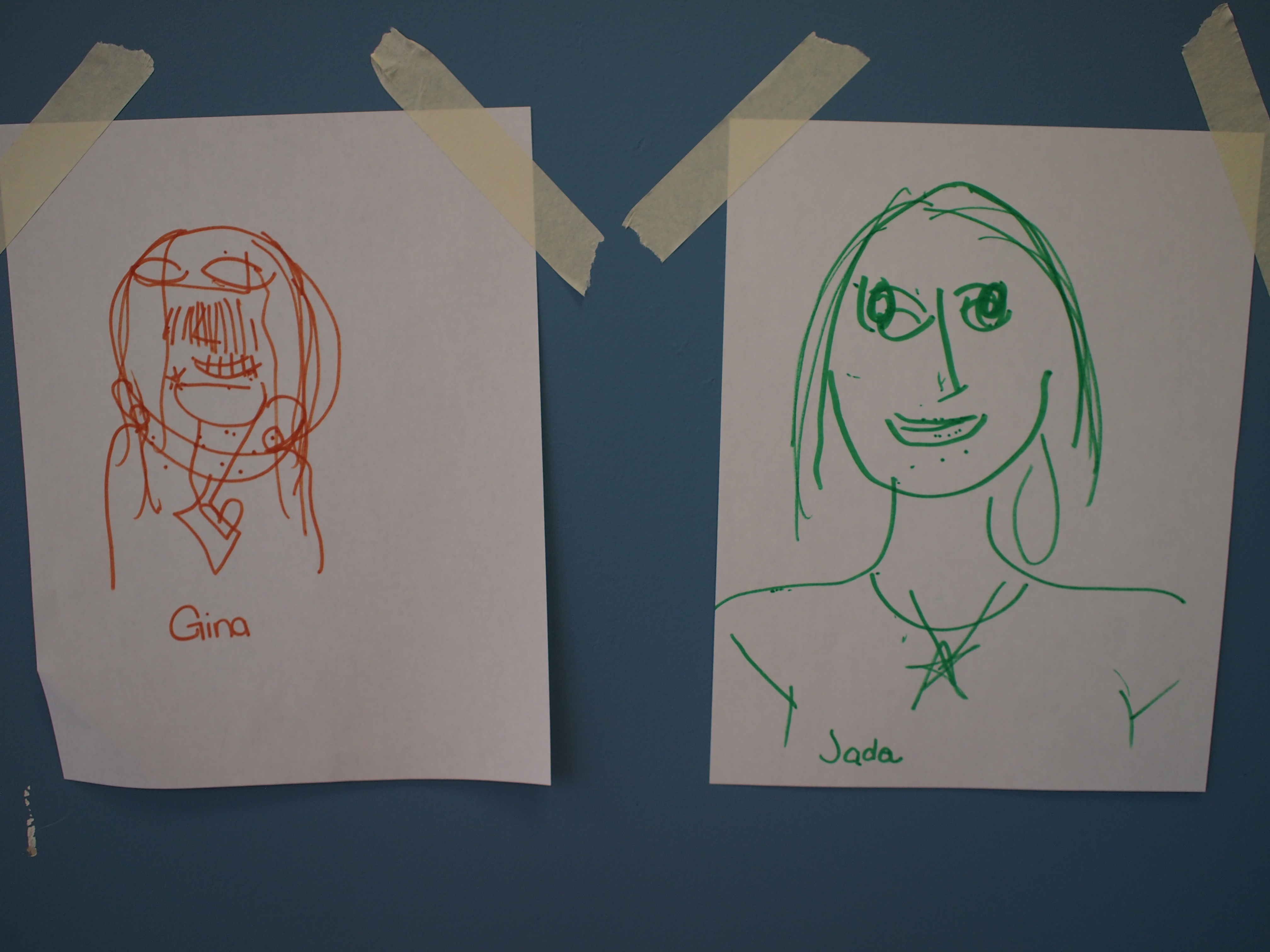
At the beginning of last school year, we did a fun little activity during one of our PD days. You sit across from a partner, paper on the table and markers in hand. You then have one minute to draw a portrait of your partner.

The catch? You can’t look down.

One tense minute later, you have a lot of hilarity on the page. People pass the papers around; several of ours ended up on a piece of string and were displayed all year in the main office. We talked about what we focused on (hair style! earrings!) and what we left out or messed up (ears, noses, eyes, mouths…)

I totally forget who on staff presented this activity; kudos to them. Ostensibly it was shared as a “you can do this with your kids” sample. But the key thing was that we enjoyed doing it ourselves. As teachers, I would argue that we have an even lower tolerance for crap than our students — if it’s insincere, or pointless, or boring, our alarms go off right away. Talking to teachers around Philadelphia, I heard plenty of stories about new initiatives, slogans, or activities that were being handed down to teachers at the beginning of the year — stuff that has been developed and tested and standardized for maximum effectiveness… and that you know in your bones kids aren’t going to buy into. If it doesn’t have legs in the teacher’s meeting, it is destined to fail in the classroom.

I kept the partner portrait activity in the back of my mind for a while, and then we busted it our with our new freshmen advisees on the first day of school. An awkward first hour melted away to instant laughter.

“We did this last year,” I told them. “You should see ours!”