Category Archives: Curriculum

Truth and Storytelling: The Things They Carried

In an attempt to follow Diana Laufenberg’s lead, I’m going to share my first full unit plan here.

At SLA we all plan using Understanding By Design, and in English that means thematic units. So when I first planned around “The Things They Carried” by Tim O’Brien, the obvious ideas that came up were around truth and storytelling.

Here are the essential questions for the unit:

•    How are we the stories we tell? What makes a story universal?
•    What is the difference between “truth” and “fiction”?
•    How can war change a person?

The unit also seeks to answer one of the three grade-wide essential questions, around the theme of change:

•    What is the relationship between the self and the changing world?

The book is a great one to start the year–it’s easy to read, but hard to understand, which makes for easy buy-in and killer class discussions. On day one, look at a photo of Tim O’Brien:

We then read the book’s dedication:

This book is lovingly dedicated to the men of Alpha Company, and in particular to Jimmy Cross, Norman Bowker, Rat Kiley, Mitchell Sanders, Henry Dobbins, and Kiowa.

and front matter quote:

This book is essentially different from any other that has been published concerning the “late war” or any of its incidents. Those who have had any such experience as the author will see its truthfulness at once, and to all other readers it is commended as a statement of actual things by one who experienced them to the fullest.

– John Ransom’s Andersonville Diary

Who are the two groups who will read this book, and what is the difference in how they understand it? That’s the set up that we return to several times throughout the unit. Sometimes with delightful student frustration.

Check out the unit plan here. I will also feature some activities with descriptions on the blog this week.

Rewriting the Debate: #engsschat follow up.

The day after the debate, our 11th graders came into class hyped up to talk about what they had observed. I knew they would be devoting time to discussion in History, but I also wanted to link it back to the idea of presenting facts and statistics truthfully.

We started by reviewing some of the logical fallacies listed on the poster and asked what they marked on their bingo cards. Some moments mentioned:

  • Emotional Appeal — Obama mentioning his Grandmother, Romney mentioning struggling Americans who he met on the campaign trail.
  • Composition/Division — Romney using the example of Health Care in Massachusetts as good for all states.
  • Ad Hominem — Less of this than any of us expected, but some veiled comments about Romney’s wealth and business background.

For the second half of class, students logged on to Moodle and were given the following instructions, to be completed in their groups of four:

1. Go to the NYTimes Fact Check Blog, browse a little, and pick one moment where a candidate mislead or straight-up lied during the debate: http://elections.nytimes.com/2012/debates/presidential/2012-10-03#fact-checks

You also need to find that moment on the transcript: http://www.cnn.com/2012/10/03/politics/debate-transcript/index.html

2. Get that moment approved by Ms. Pahomov, and then do some research to find out what REALLY should have been said.

3. Write a new, truthful version of their comment and post it here. Do NOT have the candidate saying something that would hurt them. Maybe they need different statistics, or a different angle.


Students gravitated towards issues like education, food stamps, and job creation. When it came to the simpler stats — (“Romney said Massachusetts was #1 for schools, but trustworthy groups rank them #2!”) I encouraged them to pick more complex issues.


Simply put, the discussions during this activity were killer. Some of the issues I heard being discussed: How do you really calculate something like job creation? What argument would defend cutting education spending?” What is the candidate actual plan on x topic?


Here’s one example of their work:

What Mitt Romney should have said on education cuts:

-Yes Mr. President I plan on cutting a lot of things in order to help our economy. My plan is to not cut so much money that it will hurt our education system but to actually help it in the long run. By cutting programs we will lower our deficit, but your education plan will actually raise it. My education plan is essential and will greatly help our economy.

The final product was a sound byte of speechwriting — but the mental process, I hope, will support their analytical thinking as they keep researching and drafting their 2Fers essays — one big reason why, as an English teacher, I was thrilled to tackle this topic.


#Engsschat Reflection: professional collaboration in action!

While participating in #engsschat today, Diana Laufenberg asked what people were doing around the election. She brought up the idea of looking for logical fallacies, which in turn reminded me of this poster:

Click to see bigger versions and/or to download

I knew Laufenberg had done a State of the Union bingo with her history classes in previous years… what if we applied this to the election? In English, we are working hard on our skills of analytical writing, with some persuasion naturally thrown in. Reviewing these fallacies would naturally support our essay work, and what they observed during the debate could then be discussed after the fact in American History class.

We teased this idea out during #engsschat, and then I shot of a quick e-mail to the 11th Grade English and History teachers at SLA. Is this definitely going to work out, or look anything like I just described? I can’t say for sure, but we’ll end up with some variation on this idea for sure.

That’s a part of the point of this post — to showcase a little moment of teacher collaboration as it’s being worked out. Watch this space for what we come up with, and how it goes. And steal this idea and build a plan for your own students!

Like teacher, like student: partner portraits.

I had originally envisioned this post as a first-day-activity suggestion, but now the first days of school have pretty much passed. Then I realized there’s another purpose to sharing it.

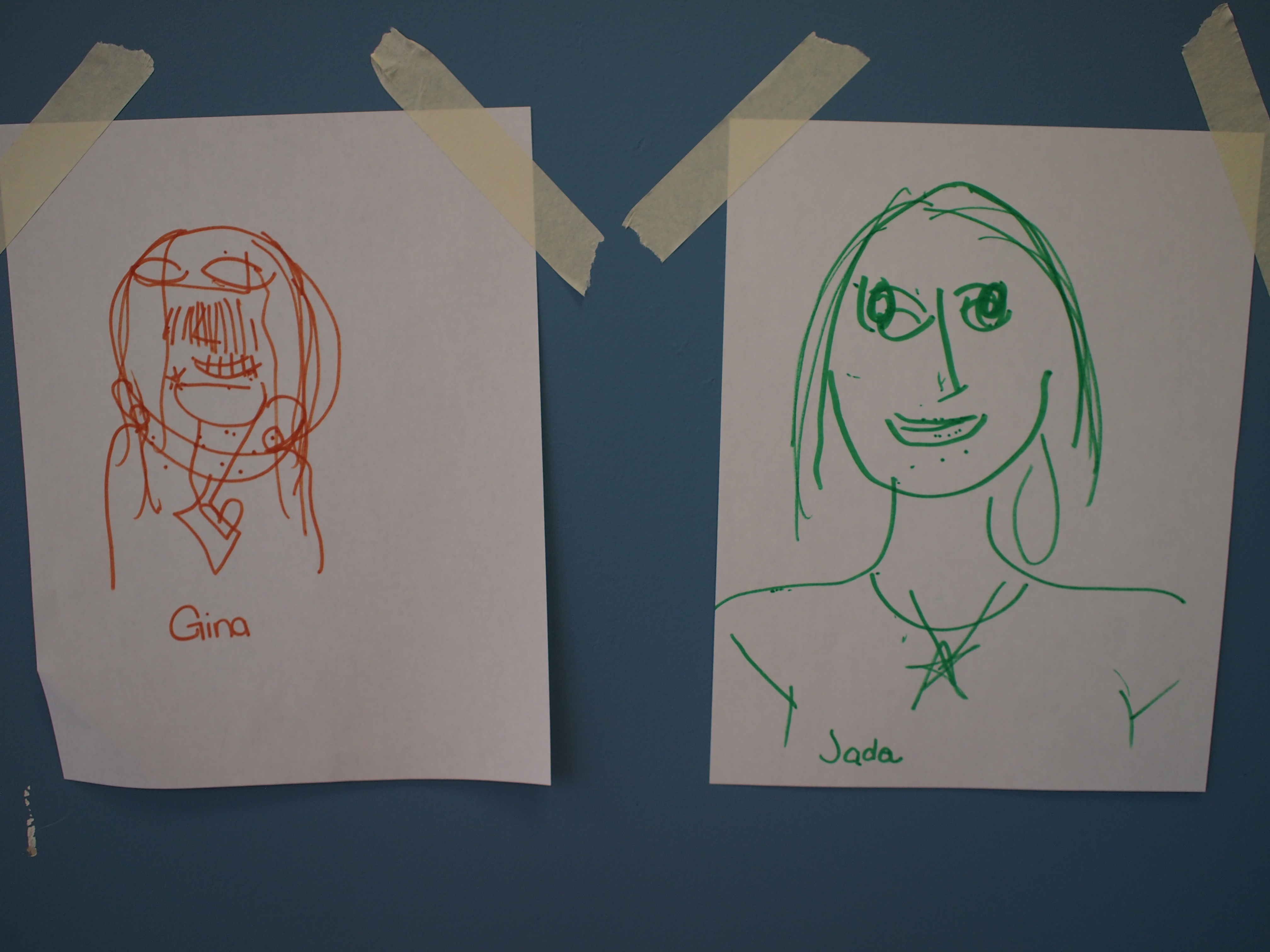
At the beginning of last school year, we did a fun little activity during one of our PD days. You sit across from a partner, paper on the table and markers in hand. You then have one minute to draw a portrait of your partner.

The catch? You can’t look down.

One tense minute later, you have a lot of hilarity on the page. People pass the papers around; several of ours ended up on a piece of string and were displayed all year in the main office. We talked about what we focused on (hair style! earrings!) and what we left out or messed up (ears, noses, eyes, mouths…)

I totally forget who on staff presented this activity; kudos to them. Ostensibly it was shared as a “you can do this with your kids” sample. But the key thing was that we enjoyed doing it ourselves. As teachers, I would argue that we have an even lower tolerance for crap than our students — if it’s insincere, or pointless, or boring, our alarms go off right away. Talking to teachers around Philadelphia, I heard plenty of stories about new initiatives, slogans, or activities that were being handed down to teachers at the beginning of the year — stuff that has been developed and tested and standardized for maximum effectiveness… and that you know in your bones kids aren’t going to buy into. If it doesn’t have legs in the teacher’s meeting, it is destined to fail in the classroom.

I kept the partner portrait activity in the back of my mind for a while, and then we busted it our with our new freshmen advisees on the first day of school. An awkward first hour melted away to instant laughter.

“We did this last year,” I told them. “You should see ours!”

Test prep, part 4: the little guys.

You might expect that the phrase “the little guys” to be some kind of diminutive for those humble, overlooked students who just need more attention when it comes to test prep.

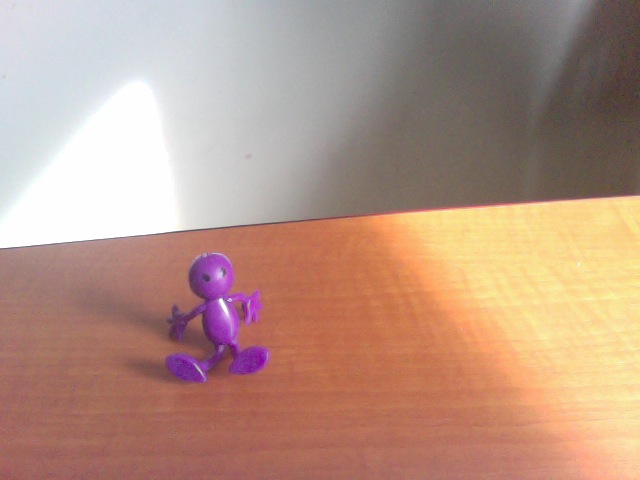
In fact, “the little guys” is what we’re calling the small plastic figures I gave my students who are PSSA testing next week.

Purple little guy.

Once the news broke that there was no way I would be proctoring tests with my own students, I wanted a way to be in the room with them. A few google searches later and I had these little tokens for a few dollars a dozen.

Call it a totem, or a good luck charm, or an avatar — although I didn’t use any of these phrases when they first got distributed. I handed them out when we were working on a practice test — kids picked the color they wanted, purple’s just one iteration — and asked them to think about what their little guy needed to say to them when I’m not there in the room.

You are unique snowflake?

Slow down?

Wake up?

Write more?

We agreed that frustrations could be taken out on the little guys (provided that it doesn’t get noisy or do any lasting damage.) Plus their joints bend, so you can have them be a little active for you when you’re stuck in your seat.

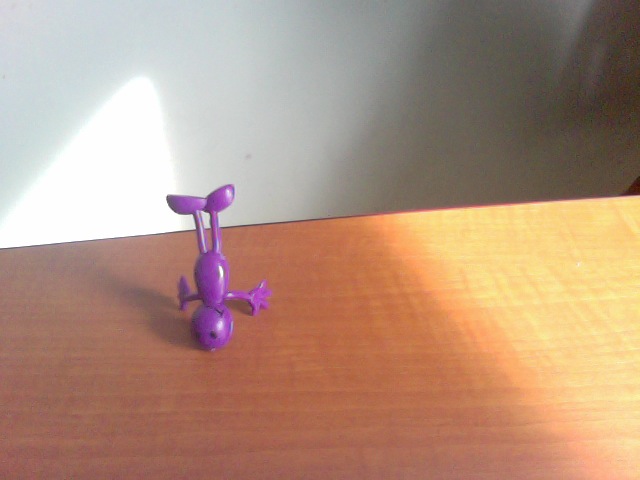
Turns out the little guys are not so good at standing up, but they do sit. They can hug each other pretty well. And they can stand on their heads.

Look ma!

Look ma!

I will have you know, this official instructional method is Testing-Coordinator-Approved. And in a week that has been a little low on excitement, my 11th graders are feeling good about the little guys. A little island of play in a big sea of multiple choice bubbles.

One way we introduce projects at SLA.

SLA Science Teacher Tim Best asked for some best practices around this question, and then SLA History Teacher Diana Laufenberg pointed out my answer could be a blog post. So here we go:

People often wonder how we go about explaining projects to our students. Obviously, with many being open-ended in both topic selection and what the final product looks like, sometimes the details are fuzzy for a reason.

After my first year working here, however, I learned to anticipate the kinds of questions kids would ask about a project —  the parameters of the subject matter, the timeline, etc.

Now, every time I do a project write-up, I follow it with a “frequently asked questions, as imagined by Ms. Pahomov” where I write questions and answer them in short paragraphs. I read this to them along w/ the general description. It helps address a lot of obvious questions, and can also be referred back to a week later, when kids have forgotten what you said.

Here’s a (long-ish) example of how I pitch the podcast project to our 10th Graders. And yes, I will post a full write-up and reflection of this project sometime soon.

Q3 BENCHMARK: “Crossing Boundaries” podcast.

Your task this quarter is to create a podcast around the theme of “crossing boundaries.” The final product is a 12-15 minute podcast which tells a true story (or series of related stories) related to this theme. You are responsible for identifying an engaging story, conducting the necessary interview/s, editing the content, and adding narration, music, and any other components that are needed.

This project is divided into two phases:

PHASE ONE is identifying the best story to share, and planning your content. In order to do this effectively, you must brainstorm SEVERAL ideas–and then get public feedback and look into how easy it will be to get the interviews you need. It is your job to settle on an idea, map out your podcast, and complete at least ONE interview by Tuesday, Feb. 21st.

PHASE TWO is the completion of your final product, which you will have several in-class work periods to complete. This time will be useless if you have not yet completed an interview–make sure you complete phase one on time!

The final podcast is due Tuesday, Feb 29th. It will be posted on our class blog — AKA you are making a product for the general public to enjoy!

Frequently Asked Questions (as imagined by Ms. Pahomov)

I really don’t have an idea for a theme.
We are going to brainstorm in class — start by looking around your own world and think about who has done something out of the ordinary. Did they flaunt a social norm, or challenge a long-standing rule or expectation, and why? It doesn’t have to be a life-or-death situation. You might find inspiration by looking at the rules from our “Boy/Girl” stories, and figure out who has ever crossed one of those boundaries.

Can I tell lots of little stories? Each of my friends has a little funny story.
Most of you will focus on ONE larger story — this is more interesting for the listener. If you have a very clever theme, you might have unrelated anecdotes from different people. But don’t have totally random stories that all relate to “crossing boundaries” in different ways — that’s just lazy.

Can the story be about myself?
Yes, but you have to have an interview with at least one other person! You could potentially record an interview/conversation with you and somebody else who was involved in the story, talking about what happened and reflecting.

I have the world’s BEST story and it’s going to be an hour long. Is that ok?
No. This is one of the time where I am going to be draconian about a limit on the project — your podcast can really not be any longer than 15 minutes. If it is longer, I will simply stop listening at the 15 minute mark, and that will make your podcast sound like it’s incomplete. Use your editing skills!

I want my grandmother to tell her life story. Ok?
No. I’m sure your grandmother is nice and all, but hearing every detail means there’s no focus. What’s the most interesting boundary she ever crossed? Is she a forgotten Rosa Parks? Did she dress like a punk when she went to church? Zoom in on a moment like that.

“Analysis Must Show Thought”

This post is me collecting my thoughts in preparation for the #Engchat discussion I will be helping out with on Monday, 2/13. We will we talking about teaching analysis skills — and not because I am an expert on the topic. Because, in looking for resources and suggestions, I browsed the Engchat vaults, and couldn’t find any chats around this theme.

My awesome #ux students do some analysis & synthesis on literary interactions

What I have noticed in my class is that analysis is something I tell kids to do a lot, but don’t necessary explain. Here’s some examples of what I say, usually to help with analysis in writing:

“Analysis comes after the context and the quote in your body paragraphs. And it should be the biggest part of each paragraph.”

(What, like a big cut of meat? That I can put on the scale for a grade?)

“Analysis should always justify your example, and explain how it relates to your thesis.”

“Don’t summarize, analyze.”

“You analysis should explain the how or the why behind something, not just take a position on a topic.”

What it all seems to boil down to, though, I stole from fellow SLA teacher Matt Kay:

“Analysis must show thought.”

Are you thinking? Are you thinking? Are you thinking?

(Quick, where’s my think-o-meter?)

So I’m interested in exploring all the little tips and tricks that can help massage students’ thinking. But most of all I am asking myself — how do we create a culture where that great analysis can happen in the first place?

Creative Commons photo via Flickr.

Starting up the 2Fer tradition.

In the last year, I have made a few presentations about using Google Docs as a venue for student essays at SLA. During those presentations, I tended to gloss over the assignment we first adapted for GDocs — which is a shame, because it deserves its own moment in the spotlight.

The original brainchild of Mr. Chase, the instructions for 2Fers currently read as follows:

A 2Fer is an analytical paper on any topic you choose. There are four basic guidelines that must be followed:

1. The 2fer has a thesis statement that is unique, insightful, and debatable. It does not re-state a commonly held belief or choose sides in a worn-out debate — it reflects an observation and conclusion you have come to on your own.

2. The 2fer uses at least two outside sources to support your thesis, and cites them correctly. This includes integrating the information seamlessly into the text of your essay, and using correct MLA citation for both the in-text citation and the works cited page.

3. The 2fer never uses the first or second person (“I” or “you.”) Instead of writing “I think that…” just write what you think!  If you quote a source where the speaker says “I” or “you,” that’s fine.

4. The 2fer proves its thesis statement through the quality of analysis and factual support, not raw force of opinion. Avoid topics where your personal feelings dominate the paper, or rely heavily on individual experiences or beliefs (the existence of an afterlife, the nature of love, etc.) Look instead for topics where there is a wealth of credible outside material you can mine for support. A well-written 2Fer doesn’t argue, it proves.

You want to write about the magazine you’re reading? Do it. The video game you’re playing? Awesome. The mysteries of SEPTA? Absolutely. Are you feeling meta today, and want to attempt the 2Fer-about-a-2Fer? A valiant endeavor, where many students have gone before (with amusing results.)

This freedom of choice is obviously a blessing and a curse. To help students narrow it down, we’ve been talking about how to come up with a viable thesis statement — which, of course, first requires that you ask the right question. See the slide deck below for a glimpse into our conversations.