What keeps our kids going?

During 11th grade English today, students were presenting their “Problem in Philadelphia” research mini-projects, our principal happens to walk in during the group working on “Teen Motivation after High School.” (I know, I know. You can’t make this stuff up. Lehmann walking in is actually a non-event, and if the kids had some reaction to his presence, they didn’t show it.)

The group included the following graph in their presentation, which they later cited as being from The Philadelphia Public School Notebook.

college-going-rates-school-type

Their snapshot assessment of why these numbers are the way they are?

Students at neighborhood schools don’t have the support structures that are offered at SLA.

Now, they’re not experts about what goes on in schools across Philadelphia — and neither am I. But this idea of community and support continued to be echoed through the class. During Q&A, Lehmann followed up on this idea, asking them: what keeps you guys from dropping out? What keeps you motivated? Everything they listed was both structural and human — our ILP internships around the city, the Math Lab and Lit Lab that offer tutoring and study space during lunch, our Student Assistant Teacher Program (which they were shocked to learn doesn’t exist at any other school in Philadelphia.) That the teachers care. Our four-year advisory system.

Not one student said “we’re smarter” or “we’re just more motivated.”

In fact, it only occurred to me now, upon reflection, that they could have said that. Because that’s the argument leveled against the special admit schools sometimes — that those kids are going to succeed anywhere, so pulling them into their own environment just skews the numbers.

I agree that the numbers are skewed. But my students offered a very different, big-picture viewpoint about why. And they’re the ones who know it personally.

Project Based Learning, Session 2

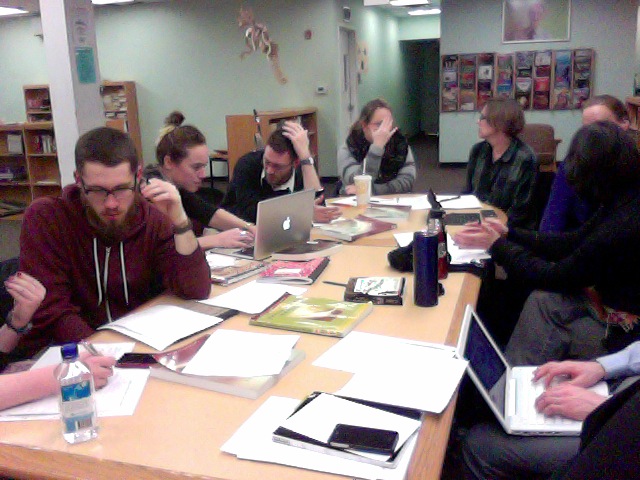
Photo on 2013-02-20 at 18.10Going into the session, folks had been asked to brainstorm what unit they would like to transform or create in the project-based framework, and maybe write a couple of essential questions that they thought would be useful.

Stuff From This Week

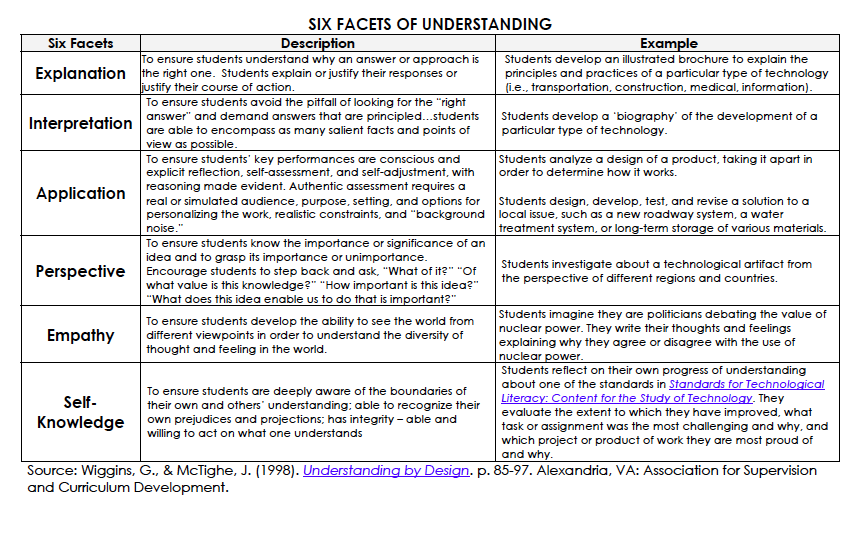
We looked at a few documents outlining key ideas behind Understanding By Design, including the “six facets of understanding” described below. People were asked to discuss: which of these are you already hitting in your classroom? Which are eluding you and/or your students?

Screen shot 2013-02-20 at 7.27.24 PM

Next up, we looked at a cheat sheet of sorts — “question starters based on the six facets of understanding.” You can find the full list in this document; here’s a sampling:

Explanation

  • Who_________?  What__________?     When _________?     How________?     Why_______?
  • What is the key concept/idea in ____________________________________________?
  • What might happen if _______________________________________________________?
  • What are common misconceptions about _______________________________________?

Interpretation

  • How is _______________________like ________________________(analogy/metaphor)?
  • How does _____________________________________________________relate to me/us?
  • So what? Why does it matter?

Application

  • How and when can we use this (knowledge/process) ____________________________?
  • How is __________________________________________ applied in the larger world?
  • How could we use _______________________ to overcome ________________________  (obstacle, constraint, challenge)?

Perspective

  • What are different points of view about _____________________________________?
  • How might this look from ______________________________________’s perspective?
  • What is the evidence for ____________________________________________________?

Empathy

  • What would it be like to walk in ____________________________________’s shoes?
  • How might ___________________feel about _____________________________________?
  • How might we reach an understanding about ___________________________________?

Self-Knowledge

  • How do I know________________________________________________________________?
  • What are the limits of my knowledge about ___________________________________?
  • How are my views about __________________shaped by ________________________ (experiences, assumptions, habits, prejudices, style)?

The real meat of the evening, however, was when SLA English teacher Matt Kay talked to us about his process for writing essential questions. He shared his process for the book “Kindred,” which he teaches to 9th graders. His Essential Questions for his unit are:

  • What is the relationship between who we are and what society expects of us? (What does society expect of us?)
  • Okay I didn’t get the other two written down… but they were good.

He tweaks his wording every year, as “after teaching for seven years, you get intimate with a novel.” His questions have also gotten longer, instead of shorter — he edits his questions to reflect the kinds of questions students themselves are asking. He also has a sort of floating Essential Question that he uses for creative prompts: “If you were this character, what would you be doing?”

None of these EQs, he noted, are skill-based. These the things they are going to be troubling with, and “never really find an answer to.” He builds questions that they can wrestle with — if not, it’s not a good essential question.

He doesn’t give them all three at once — introduces them as they appear in the book.

Q&A with Matt Kay

Do his students know the phrase “essential question?
Yes, although eventually wants to fool around with them creating their own.

What role do the questions play for his students?
As discussion starts, all of these can be prompts for class discussion. A class often starts with “what happened” in a book, but the questions can help draw the discussion deeper, and link between days. You want to make them okay with the idea that they’re reaching toward something that they’re not going to get — but they’re not feeling frustrated by that. It’s a puzzle that they never quite fix.

As for the six facets of understanding, “empathy” and “self-knowledge” are the two that you have to reach for. Asking the hard questions is the challenge — often for the teacher as much as the students.

What happens if kids go in a different direction?
Give kids power and agency — let them know they have brought up something new and interesting — it removes the barrier between teacher and student.

Essential questions are easy to apply to a classic, literature discussion. How do you use them for units based around skills and content?
Matt gave an example from his “grammar boot camp” unit — “How does someone’s language affect the way other look at them?” He shows papers from last year (with the names taken off) and asks what judgments they make about those students — are they smart? are they good students?

It’s about the “why” of the skill, and the dangers of not having it.

How do you know that the project-based inquiry model is working?
Who’s asking the question? You know it’s landing when students are asking higher-order questions on a regular basis. If you still have to ask all of the questions, they haven’t absorbed the intention of PBL and understanding by design.

I then noted that this version of “success” can get skewed — kids can ask higher-order questions all day but get nothing explicit “done” — so I asked: so how do you find balance?

Matt’s response to that: for PBL to be successful, kids take initiative on their own projects. Instead of asking “Can I,” they approach him with things they have stated. They gain a confidence to start things — even if they don’t have all of the skills in place. And they don’t always need a prompt.

Everybody went home with UBD Template instructions as well as a Blank_UbD_Planning_Template. The goal for next week is to have “Stage 1” planned out — at least a rough draft, so we can compare and refine during the next session.

Happy planning everybody!

Related post: Project Based Learning, Session 1

Working through school wounds.

This activity is a continuation of my write up from yesterday about getting students to identify what their “school wounds” are.

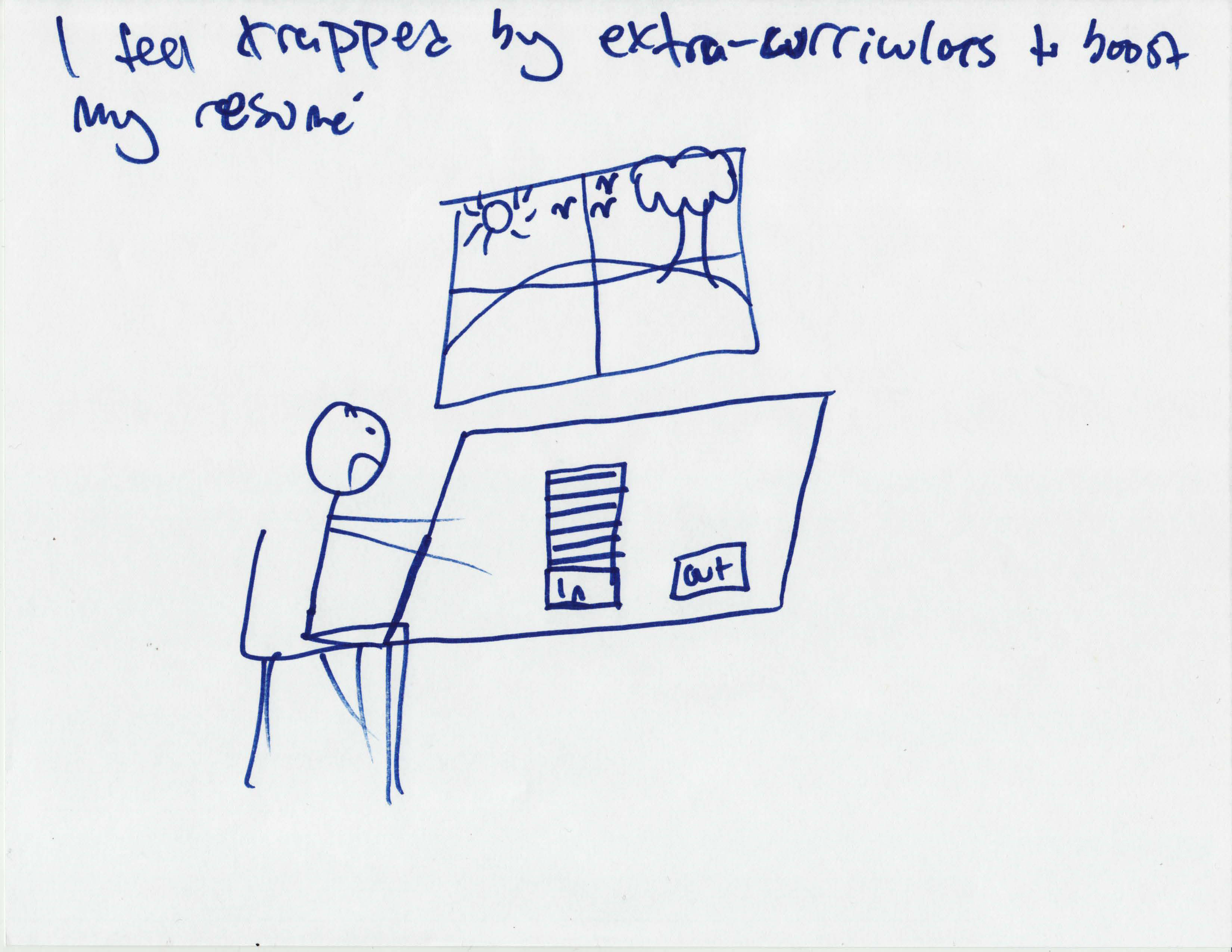
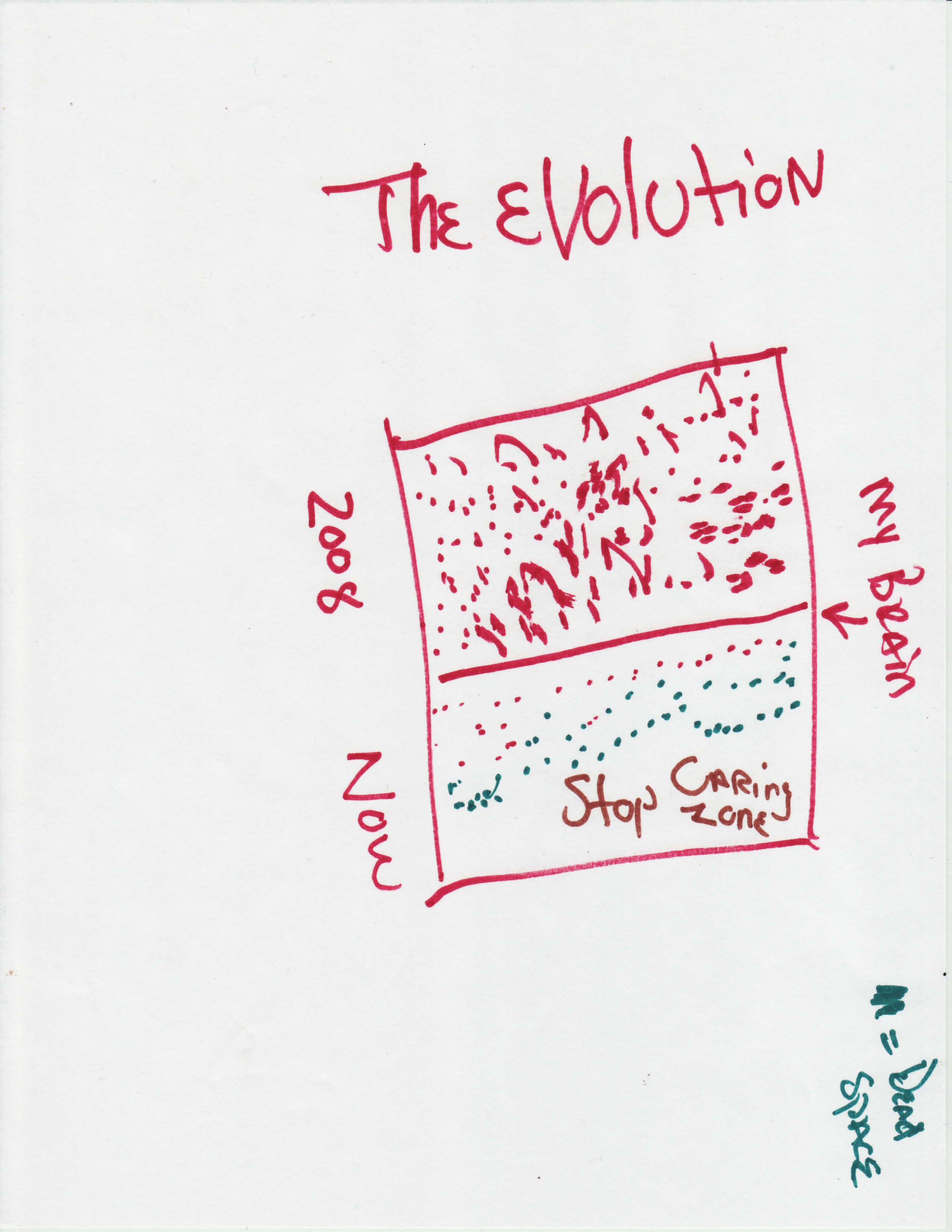
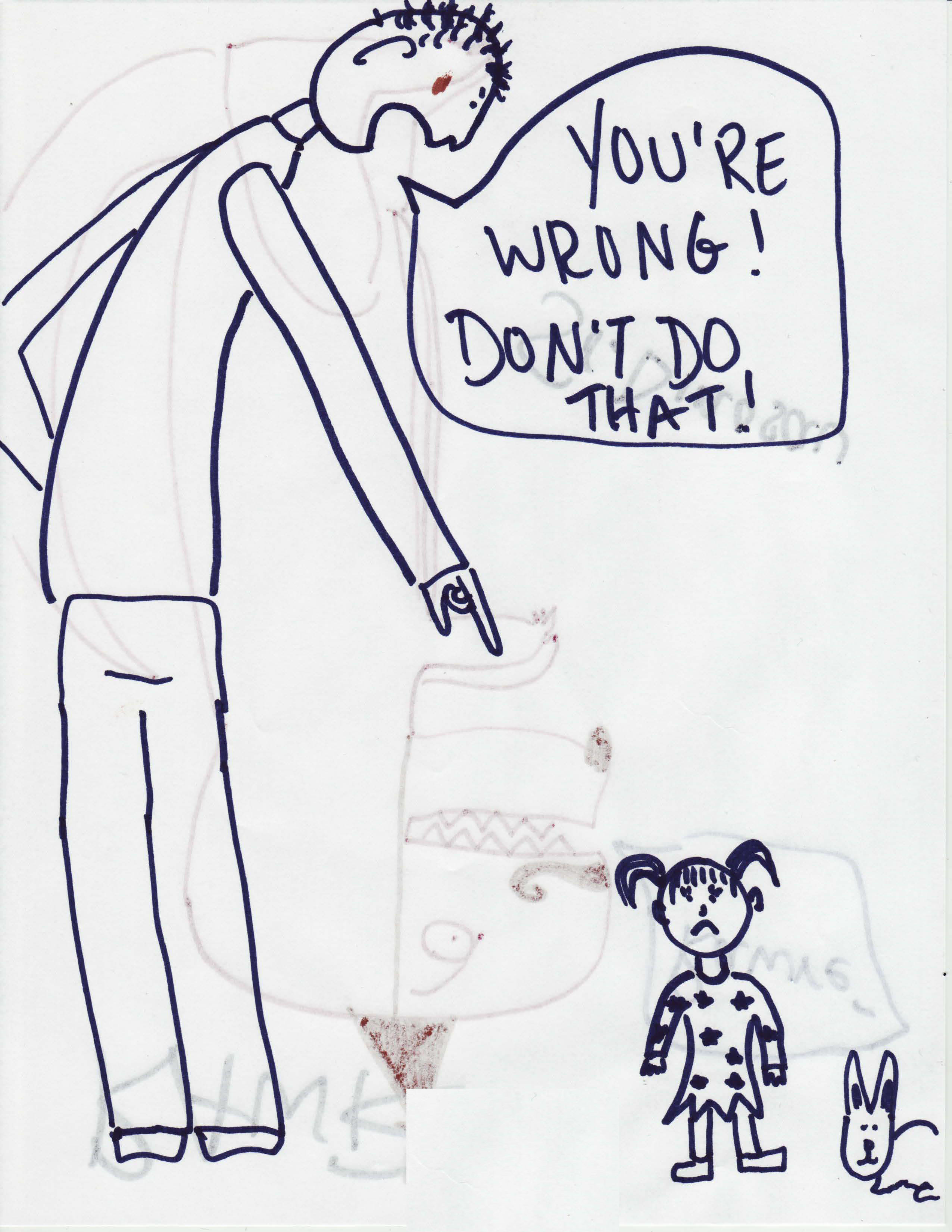
Once students had picked a category they identified with — numbness, creativity, compliance, underestimation, or the average — we handed out some blank paper and asked them to draw:

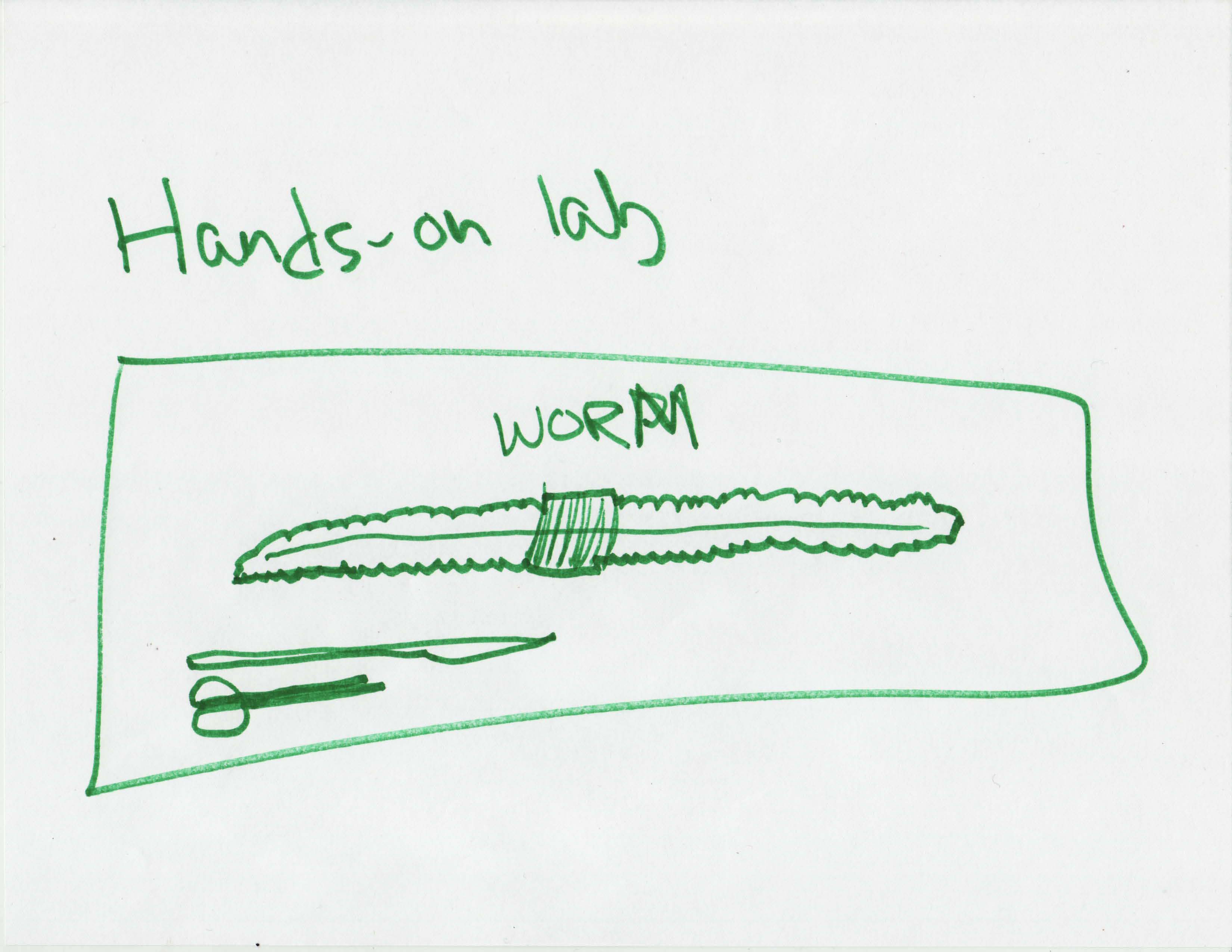
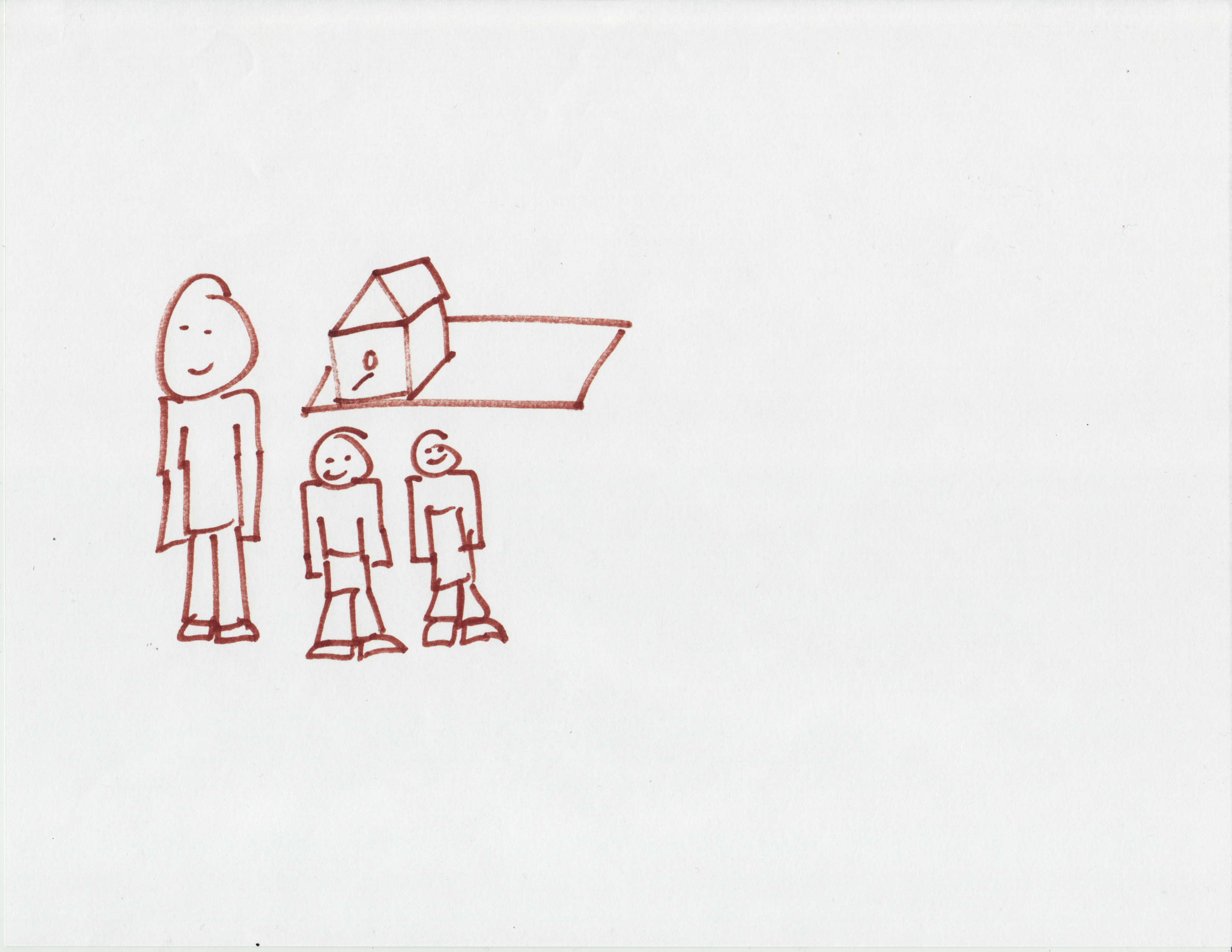
What was an experience that made you lose your desire to learn?

The results were sometimes predictable, sometimes unexpected, and often hard to look at and accept.

Wounded By School_Page_7 copyWounded By School_Page_9 Wounded By School_Page_8 copy       Wounded By School_Page_1

We talked a bit about where all this was coming from — many different places, obviously. If this was had been my English class, we would have been composing essays / digital stories post haste. As this was the spring of senior advisory, however, we took a more mellow, holistic approach, talking it out in groups.

We also followed up with a second, positive prompt:

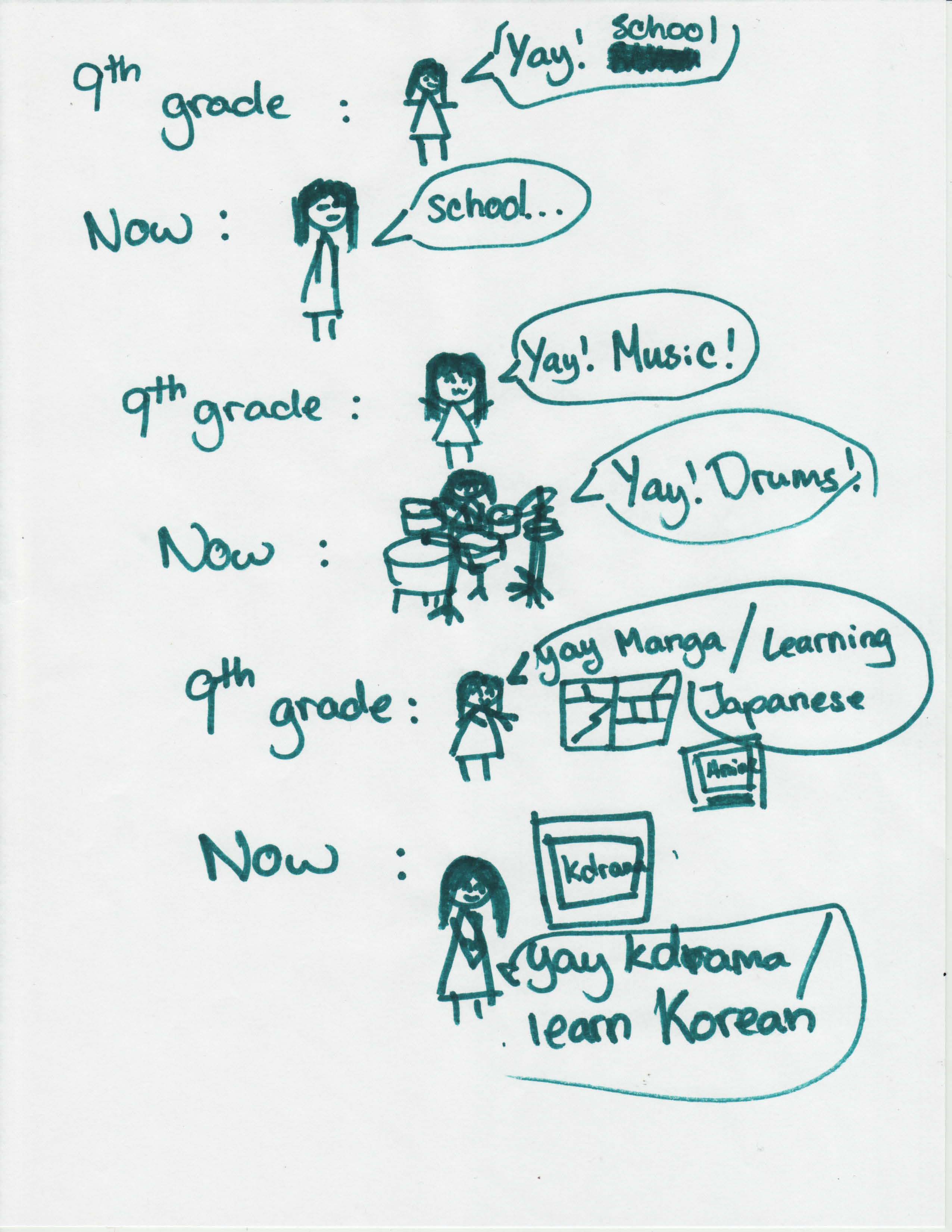
When was a time that learning came alive for you?

Wounded By School_Page_3 Wounded By School_Page_2 Wounded By School_Page_6 copy Wounded By School_Page_4

I have to admit, I was a little bit relieved that several of the drawings kids created were directly related to school. I also liked this one, which showed a timeline of many different influences on learning, both school-based and self-chosen:

Wounded By School_Page_5

Our final push with this activity was along the lines of, “you’re going to college soon. You probably have four more years of “formal” learning in front of you, and some more hurdles to jump with school. How are you going to heal your wounds now, and get through this?”

Of course, looking at it now, I don’t think that line of thinking pushed hard enough. In fact, I think it was sort of cowardly — asking students to accept the poor structure of school at face value and just “deal with it.”

The question I want to ask now:

How could we all transform school, so that these wounds don’t happen?

Helping students identify their school wounds.

Last year I had the good fortune to read Kirsten Olson’s book Wounded by School: Recapturing the Joy in Learning and Standing up to Old School Culture. So many of the ideas raWounded-by-School-9780807749555ng true, I immediately began brainstorming ways to share them with my students.

The activity I developed was for my senior advisees at the time, with the notion that, now that their secondary schooling was drawing to a close, unpacking it would be a useful task in preparation for getting through college.

Of course, why not do it earlier, and then reap the benefits yourself? My wake-up call about what students think of learning in my classroom has me itching to do this activity with my freshmen advisees. And possibly with all of this year’s freshmen.

Phase One: Identification

In this first phase, I read them a few passages from the book — the fact that she had been at EduCon that year didn’t hurt with the buy-in — and then students were presented with a series of statements pulled from the chapter “Kinds of Wounds.” The statements for each category were clustered on a table, and students had to tour the room and eventually pick a the group of statements that best reflected them. (The “categories” of wound were not included — I’m just putting those here for clarity’s sake.)

Wounds of Numbness

  • I feel detached from learning and zone out a lot in school.
  • I have lost interest in learning experiences I once enjoyed.

Wounds of Creativity

  • I feel like my original ideas lack value or are too strange.
  • I feel like everything I have do to has to “add up to something.”
  • I often I feel like I won’t be good at new things.

Wounds of Compliance

  • I worry that something will go wrong if I don’t follow the instructions or the rules.
  • I try not to stick out.
  • I do things because they will look good for college or my resume, not because I actualy want to.

Wounds of Underestimation

  • People don’t really know who I am in school — they just make assumptions.
  • People assume I am capable of less than I actually am


Wounds of the Average

  • I can only achieve so much in school.
  • I don’t feel like I get much attention in school, or that my work is valued.
  • Maybe I could do better, but people just expect me to be average.

Once they picked a group, students had time to casually share out: why did they identify with those statements? What were the typical or stand-out experiences that made it clear that’s how they felt? Had they always felt this way? If not, when did that wound form?

A lot of students picked “numbness” — senioritis was in full swing — and some self-identified overachievers gravitated towards “compliance.” “Underestimation” and “average” got some takers as well. Those last two groups were initially more reticent to share why they felt the way that they did — but once they got going, they had a lot to say. Perspectives I have never heard before.

The conversations were deep enough that this took the majority of an advisory period. I think we asked students to share out their history and current gripes with their wound, and this worked because our advisory family had four years of trust built-in by this point.

Part 2 of the activity — complete with drawing! — coming tomorrow.

What are students really “getting?”

Last year, Heather Hurst spent a year observing one of my 10th grade English classes as the field research for her PhD work at UPenn. Her focus was critical pedagogy in the classroom.

As a part of her research, she took complete transcripts of every class that she observed. She did me the very nice favor of sending these to me as soon as she wrote them up, which was an amazing (and sometimes mind-bending) view into my classroom and my practice.

This week, she sent me the draft of her dissertation. This gave me access to something new — the student interviews she had completed throughout the year. She asked a bunch of questions, conveniently listed at the end of her document. Here are a few that stood out to me:

  • If first interview: What do you think your English teacher’s goals are for her classroom? Are those goals important to you?
  • If second interview: In our last interview, you said you think Ms. [Pahomov]’s goals are ____________. Are there any that you would add or take away now?
  • Did you ever feel that your English class was preparing you to change anything in your neighborhood/community/city/state/country/society?
  • What could you use from English class to change the world you live in for the better?

You can probably imagine what I would hope their answers would resemble. That they would get some semblance of my emphasis on a mix of explicit skills and “big picture” ideas and theories that help them transform their reality. The 10th grade theme is “systems,” after all. Many of the units are designed to have students identify social systems around them and analyze how those systems influence the individual (often unfairly, often without them realizing it.)

On the whole, however, students saw the goals in my class as getting an A, learning how to write better, and generally not think about the “real world” outside the classroom. They did consider one of my big goals to be valuing different opinions and learning from each other — and they believed in that — but didn’t necessarily connect that to life beyond our class.

What a wake-up call. Today I am really thinking about what’s “clear” to me but opaque to students — and therefore only happening in my head.

Of course, sometimes students can’t speak on the things that are happening in their education — or choose not to.

Still, a change in approach is definitely in order. This is a piece of the curriculum that needs to be unhidden.

What needs to be “unhidden” in your classroom? Also, if you ever have the chance to have your classroom studied for a year, I highly recommend it!

Working to improve “the education sector.”

Screen shot 2013-02-15 at 10.20.07 AM

On Saturday, February 22nd, I will be speaking on a panel at the 2013 L.E.A.R.N. Conference, hosted at UPenn and organized by a few of their graduate schools (including the education school.)

According to the write up, the “View from Inside the Classroom” panel acknowledges that, “The voices of students, parents, and teachers are all too often not heard in policy changes for education reform.”

If you look closely, you might notice that, as of this writing, I’m the only person appearing on my panel. This is because they only recently created said panel. Neither parents, nor teachers, nor students are represented in any other section of the conference. (Okay, a school band is playing during lunch.) Our session is during the lunch slot, and by necessity of the schedule, 15 minutes shorter than any other panel.

Here’s the write-up of the organizing group, from their front page:

LEARN is the hub for those interested in improving the education sector.  Active projects include policy research, pro bono initiatives, and career development.  Our goal is to harness the expertise of today’s education experts to empower the education leaders, entrepreneurs, and policymakers of tomorrow.

I bristle at some of that language.

However, I’m excited to participate and push against the notions of some of the attendees (and expecting that they will also push against mine.)

Plus, I get to see Diana Laufenberg talk about technology.

Project Based Learning, Session 1
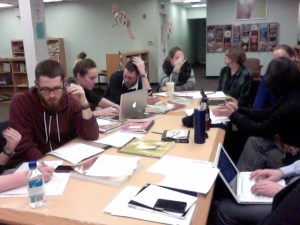
On Wednesday, the first session of the Project Based Learning group that I’m hosting met in SLA’s Library.

Going into the session, people had already read a short intro essay about Understanding by Design. We started by introducing ourselves and describing our teaching environments. I’m thrilled to have people from all grade levels and disciplines, and even two people doing special instruction via a non-profit! A big goal of this ItAG is to help people create lessons that work in their environment, no matter what that is.

We then watched this short video, and then talking about whether the video confirmed or challenged our pre-conceived notions about PBL:

We then took a look at this short “cheat sheet” describing a few core pieces of PBL. I made a point of challenging the section labeled “21st Century Skills” (as if nobody ever reflected before the year 2000!)

heptagon_red

Folks looked at the chart and read the accompanying descriptions for each skill, and had time to reflect on what they were already doing well in their classrooms, and what they were worried about.

Here are a few key questions that came out of that reflection, as shared with the whole group:

  • How do you deal with group work? Some kids will refuse no matter what. How do you get them to see the value? Extra time will be devoted to this in a future session.
  • Making it public is difficult. How do you do that?
  • How do you get projects to be above being a poster?
  • How do you get kids to take ownership? 
  • Getting them to go out on a limb – what’s the right answer? how many points is this worth?
  • How do you prevent them from shutting down? 

We then took a look at a Template PDF which introduced the basics of Understanding By Design lesson planning. I strongly recommend that you download the whole document, but here’s a snapshot of what we did.

The first step was looking at the template, where I told folks not to get overwhelmed by the number of boxes:

Screen shot 2013-02-14 at 3.47.33 PM

Next, we looked at a “before and after” series, first looking at the “original” plan and discussing what we thought the essential questions for this project could be, and how that might change the overall design of the unit.

Screen shot 2013-02-14 at 3.46.55 PM

Once we had teased that out, we looked at the “transformed” lesson.

Screen shot 2013-02-14 at 3.47.04 PM

The second example was for a high school geometry class — a valuable discussion because we hit our heads against the conflict of what makes math “interesting” — the math itself, or the social implications of it? Several of us were very interested in the connections that the unit was making to geography and packaging, but were reminded (by the math teachers in the room) that this is often a flaw in “selling” math to students — that everything BUT the actual math is presented as the cool stuff.

A few other key understandings that came out of our discussions:

  • PBL is more about the “how” than the “what” — so the lesson plans should be focused on the process, not the final product.
  • Therefore, PBL can (and should) teach explicit skills to students — how are they going to create that what?
  • Explicit skill instruction is NOT forbidden, and often necessary in PBL. That can include looking at textbooks, or giving quizzes or tests. The point is that these activities are formative, not summative.

Lastly, the take-home task: pick a unit that you would like to make PBL — either one that you already teach, or a new one to design from scratch. If you’re feeling motivated, start to brainstorm what your essential questions would be!

If you are following along at home, please post your lesson plan in the comments, as well as any questions or thoughts you have.

Thankful and frustrated at the same time.

Screen shot 2013-02-12 at 1.19.33 PMLast week, I finally joined Donors Choose. My first project — books to be added to my classroom’s independent reading library — was funded in under 24 hours.

Needless to say, I was delighted. I’m thrilled that my students have more books to read.

But I’m also frustrated. I’ve still got a printer with no ink. We do have the money for paper. But we could use some new ink cartridges. Also, another Spanish teacher. And a Librarian.

Like I’ve said here before, teachers should not have to volley for resources that any school district would actually pay for if they had the money. And while individual donations do wonderful things for schools, sometimes the glorification of that charity shifts the focus away from the harsh inequities in school funding around our country.

While I write this, City Council is having a hearing on the proposed closing of 37 schools in Philadelphia. Members of PCAPS will be speaking, including Bartram High School Teacher Anissa Weinraub.

In her testimony, she will be making the specific recommendation that Philadelphia help raise funds for education by rethinking how it collects revenue from major city players, including “taxing major center city commercial real estate holders and corporations that don’t pay their fair share” and “by taxing the mega non-profits on their real estate holdings.”

Maybe you agree, maybe you don’t. But whatever you do, don’t lose sight of the big picture. Because one day I would like for Donors Choose to become obsolete.

Related Post: I can’t grant write my way out of systemic inequality

Fitting together the puzzle of thesis and support.

passingI just finished reading a batch of Self-Reflective 2Fer Essays from my 11th graders, and a common weak spot they talked about was when your support in your body paragraphs doesn’t (quite) match your thesis.

I have been tinkering with this trouble in my mind for a few weeks. As teachers of writing, we often encourage students to pick a topic and “zoom in” early, and workshop their thesis statement too — but sometimes the statement is the cart that comes before the horse. They’ve fine-tuned it before they’ve really exhausted their line of inquiry. Then the thesis becomes a jigsaw piece too carefully cut for the puzzle that is their essay.

When we wrapped up reading “Passing” in the 10th grade, I decided to try the opposite approach, and asked a simple question:

“What are you still wondering?”

From that question, we made a list on the board. The questions often looked something like this (spoiler alert!)

  • Were Brian and Clare really involved?
  • Did Irene push Clare?
  • Would Jack have accepted his daughter now that he knew the truth?

Of course, we can’t see into the fictional future and find out what happened. (“Can’t we ask Nella Larsen?” “Nope, she’s dead.”) But we can re-write these questions so that the point towards the text, instead of past the ending:

  • What evidence does the book present that Brian and Clare are having an affair?
  • What motivations did Irene have to push Clare? What was her attitude towards Clare?
  • Which impulse was stronger: Jack’s love for his family, or his racism?

Students then received a sticky note to write down their question. They could grab one off the board, or brainstorm their own. That sticky note then became a bookmark as they hunted down a page that helped answer their question. Once they found some worthy evidence, they were handed a chart with the following questions:

  • Context – what’s going on in this scene? Give the basics in a sentence or two.
  • Patterns – what words or phrases stand out to you on this page? Write them down here.
  • Analysis  — what conclusions do you draw looking CLOSELY at those words and phrases? How does this page give some clues to your deep question?

The final prompt in the chart:

  • Answering your question – So, based on all of your close reading, how can you answer your original question? Your answer will probably take a couple of sentences.

It was not until the next day that I revealed: That closing prompt? It’s the core of your thesis, and your intro paragraph. A few students rolled their eyes: they’d been tricked! But a few of them smiled with surprise. That was a complete outline they had just done! And though the write-up was rough, with plenty of first person and opinionated statements, the inquiry was real. In most cases, the puzzle fit together.

Getting students to write about their writing.

I’ve already written a fair amount on this blog about SLA’s bi-weekly 2Fer essays. In brief, students in the 11th grade write a short analytical paper on any topic they choose, (roughly) every two weeks.

To emphasize the portfolio-style nature of this assignment, multiple 2fers live on the same Google Doc. When they finish one assignment and reflect on it, those reminders are the first thing they see when it’s time to start a new one. Then, in the middle of the year, we ask them to write a “Self-Reflective 2Fer” turning those reflections into a comprehensive thesis.

The instructions:

Your task this week is to write a 2Fer analyzing… your own 2Fer writing! The goal is to figure out HOW you can improve your writing, so your thesis statement should analyze a weakness in your composition.

Consider zooming in on one or two of the following focus areas: Thesis/Focus, Content/Development, Organization, Style, and Conventions.

One more thing… for this paper, the first person is allowed! Just make sure you’re not writing a long story about what distracts you from getting your work done. I want analysis of actual writing, not excuses why the writing isn’t there. You can and should quote:

  • — sections from your old 2Fers
  • — edits from your peers
  • — comments from Ms. Pahomov, both in your 2fers and at the end of each quarter
  • — your own “student reflections” completed after each 2Fer
  • — your edited papers that appear on the 2Fer Quarterly

Once students see that this is less work than a typical 2Fer, they relax. And then they get into it, looking at the four papers they have already written this year for patterns and trends. The goal is for them to really see how the five categories for feedback — thesis/focus, content/development, organization, style, and conventions — really connect. Here are a few choice quotes from this year so far:

“I like to take a clear stance on the topic I choose. A 2fer is supposed to do this, but I make it seem like it’s not even a topic that can be broken down into two parts. By this I mean, many of my 2fers are structured like, “The thing I support is so much better than this other thing.” Where by representing one side and one side only, I dominate one side of the topic and pound it into a bloody pulp.”

“When I get passionate about my papers, I look at it as a good thing, but it’s actually jumbling my papers up so that I list my opinions and it makes my paper biased.”

“The main problem with my writing is that I don’t know how to put the pretty bow on the top of it. And by that I mean, I don’t know how to write conclusions.”

A big advantage to doing this in the middle of the year is that their discoveries become their personal goals for the next semester — typed up in a big box at the top of their next Google Doc. The entire process becomes more customized — students know exactly what their weak spots are, and what steps they should be taking to improve. The peer editing discussions get more detailed, and the revisions go faster. This isn’t to say that they magically resolve their issues — but at the very least they know what they need to work on. Writing becomes a more transparent craft.

This post was inspired by Kate and Maggie’s Rinse and Repeat blog post. If you want more information about 2Fers, check out the slide deck below.