Category Archives: SLA

Staff planning, or: how we build it ourselves.

SLA is still in the midst of its planning week, so I thought I would describe the structure that informs our faculty work groups.

With a tiny administration (principal, secretary, and a few killer assistants), planning and organizing has always been an all-hands-on-deck affair. Since we became a full-sized school, these tasks were formalized as committees, although sometimes we avoid that term for the less bureaucratic “working groups.” Each group has a couple of rotating leaders and a short list of members. Everybody is in at least one working group, and at least half of staff are committee chairs.

I know that many schools spend their professional development days “handing down” content — whether it’s curriculum, discipline plans, trust falls, or something else. I also know that this makes a lot of people want to poke their eyes out. In contrast, virtually all of our our PD is teacher-led — and these groups have already been meeting and planning in advance of presenting to the larger group.

A couple of examples from this week:

– The Attendance group shared their reflections on last year’s attendance issues, and presented a revised proposal for dealing with student lateness.

– The Diversity committee led a workshop on working styles.

– Our Technology Coordinator (who is also our art teacher) gave us a tour of some new interfaces we will be trying out this year, in addition to Moodle and our old favorites.

– The new Curriculum committee will be guiding some unit plan improvement workshops.

– The Advisory committee will be rolling out a new program designed to help beautify and care for school spaces.

I am not going to pretend that PD is always a joy for us — but there is a sense of investment that I haven’t experienced anywhere else. We pull from all kinds of plans and structures that exist elsewhere, but ultimately what we are creating is uniquely SLA. We’re not buying wholesale into a pre-packaged plan; if there’s something that’s not working so well, we can tinker and reorganize instead of looking for a complete replacement. And we have two hours a week of staff time all year long, so people have a chance keep talking.

I know that many schools are not built for this kind of collaboration — and as a result, teachers are never asked to own anything beyond their own classrooms. The policies are rigid, and if students are hitting their heads against them, tough.

Can this change? In Philadelphia, there’s recently been a move towards more autonomy at the high school level. A part of this is the financial reality of the district; other changes, like the move away from zero tolerance and rampant suspensions, is a conscious decision on the part of the board. Response from schools was positive. Hopefully people are willing to shoulder the extra responsibility in exchange for the results.

What’s your Teacher Temperament?

Like schools across Philadelphia and the country, SLA is in the midst of preparing for our first day of school. My twitter feed is full of anxiety about meeting new students, pictures of spiffy classrooms, and conversations about the first day.

One more thing to consider: are you ready to have a productive year with your fellow teachers?

I know that schools can be highly dysfunctional working environments — and that I’m lucky to work in a building that avoids most of the typical pitfalls. But we’re still a staff with very different working styles, and with so much energy going into our classrooms, we don’t always have the time or energy to understand each other. And with dozens of committees and two hours of staff planning time each week, working together well is even more vital than in a more typical top-down school.

To help us start this year on the right foot, the Diversity committee — which looks at all varieties of issues relating to both teachers and students — presented a one-hour activity today.

Teachers took a quick assessment survey (adapted from this page) and then identified themselves as belonging to one of the four temperaments. We then all had time to read through the following charts, and see what language applied to them:

The emphasis was not on feeling bound to one particular category, but getting some language to talk about your work style. Groups had plenty to chat about, including which qualities they clashed with.

This culminated in everybody answering the following questions on a public forum:

1. Your dominant categorie(s):

2. How do you work best? (probable strengths)

3. Where/when do you need to check yourself? (possible weaknesses)

4. What challenges you? What do you struggle or clash with? How do you deal?

5. What tips do you have for others to work well with you?

I obviously won’t be posting those replies here, but some great things happened as people had a chance to respond to each others’ posts and appreciate each other:

  • People identified shared goals or work styles that they hadn’t seen before.
  • People commented on how some perceived weaknesses can also be strengths, depending on the situation.
  • The value of having a diversity of interesting and working styles became clearer — people complimented others for excelling at what they themselves ignore or don’t do well at, even when that difference might lead to clashes.

When I was designing this activity, I was a little bit nervous that it could turn into a gripe fest, with people focusing more on the weaknesses of others than their own. Plus I have zero training in personality assessment. But everybody turned a decent critical eye towards themselves, with the goal of self-improvement. Hopefully the awareness now will help prevent frustration later. I like to think that we were modeling a good process for our students.


Building a home in the real world.

At SLA, like at many schools, we emphasize the importance of doing things in “the real world.” If at all possible, projects are designed to be shared publicly, and also to make sense to the general public — not just to the people who read the instructions.

Sometimes, this means we’re posting public art next to the school. Sometimes we’re planting a community garden. Students apply to and speak at conferences, travel around the world on service trips, and generally feel connected with what’s going on beyond the school’s walls.

A bit tricker, though, is our online content. The easiest way to share is to post on our class blogs — and we do that plenty. I love reading, viewing, and listening to work posted there, but the emphasis is often more on a student’s individual portfolio than the collective effort of a project or a class.

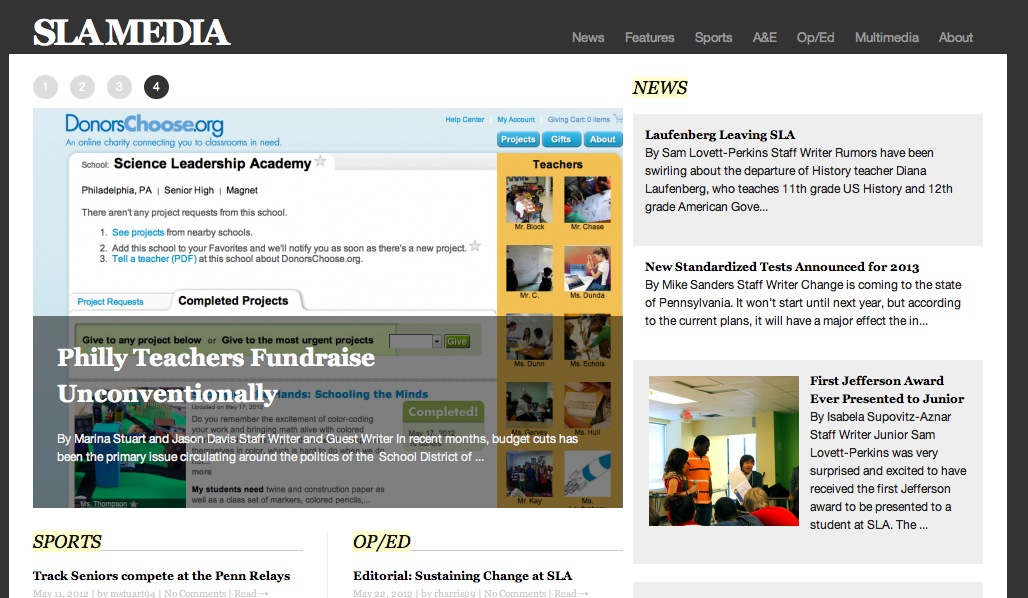
It only recently occurred to me that we could build our own spaces for those projects that benefitted from a customized home. After a week of pouring over different designs, our first Journalism class picked the template and the content areas that would  become SLAMedia.org:

Going this route made me more aware of other student-centric sites in the area, like UPenn’s The Blacktop and Mighty Writers’ forthcoming Mighty Post. When media was print-only, students were relegated to the annual newspaper poetry contest or maybe a letter to the editor. There are a few outposts for printing student writing at the “professional” level — The Concord Review  and The National High School Journal of Science come to mind — but those are few and far between.

Now that we’re online, professional venues still don’t make much room for student writing* — but they’re conveniently no longer the gatekeepers. We can set up our own showcases, not just in emulation of professional organizations but at their level.

With all this in mind, fellow 11th Grade English Teacher Meenoo Rami and I have just established The 2Fer Quarterly. 

2Fers, in brief, are short analytical essays that SLA juniors write every two weeks — on any topic they choose. If you want to know more about how to teach them, go here. But if you’d just like to get to the good stuff, watch this space in the next couple of months:


Students will be invited to post 2Fers — not every essay, but the ones they think are best — in a venue that, quite simply, is designed to be classy. Expect independent ideas and commentary on everything under the sun — science, humanities, media, politics, technology, and hopefully some criticism of 2Fer writing itself.

Are we going to get the same traffic as Slate or Salon? Goodness, no. But we know there’s an audience out there for us, and we hope that you’ll be a part of the process and the conversation.

*A notable exception is The Huffington Post, which does feature columnists who are at the college and high school level — although usually only for education-related topics.


Making Tech Meaningful.

I had the pleasure of speaking at the VAIS Technology Conference last weekend, on the theme of  “Making Tech Meaningful” — a phrase and focus that came to me at least year’s EdCampPhilly, in response to all of the gadget-y sessions that were popping up on that day’s schedule.

After I talked at them for about 30 minutes, most of the (many) questions focused on SLA’s culture and approach towards technology use towards social media.

Many of the people in the crowd were the tech coordinators or IT specialists and their schools, and their questions often reflected a culture of restriction vs. responsibility when it comes to the role technology plays with our students. Sometimes I forget that questions like “Don’t the laptops distract them?” or “What if they download pornography?” are the first things coming from worried administrators.

After the talk, many people came and said I had given them a lot to think about. After lunch, one woman came and whispered to me: “I agree with you! We should be teaching responsible use, not restricting them.”

“You don’t have to whisper here!” I replied. “Just say it!”

Test prep, part 4: the little guys.

You might expect that the phrase “the little guys” to be some kind of diminutive for those humble, overlooked students who just need more attention when it comes to test prep.

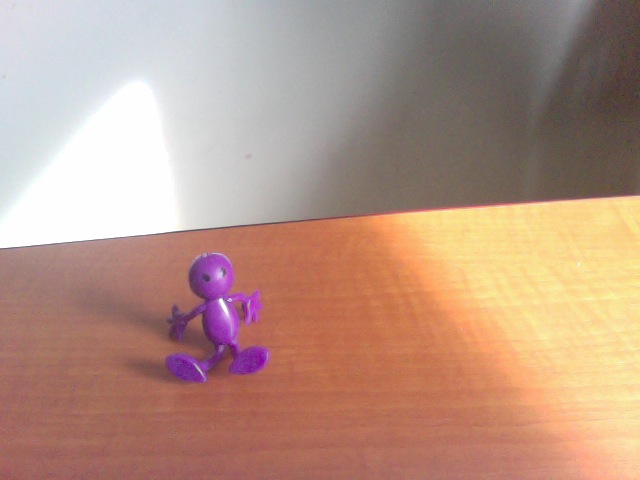
In fact, “the little guys” is what we’re calling the small plastic figures I gave my students who are PSSA testing next week.

Purple little guy.

Once the news broke that there was no way I would be proctoring tests with my own students, I wanted a way to be in the room with them. A few google searches later and I had these little tokens for a few dollars a dozen.

Call it a totem, or a good luck charm, or an avatar — although I didn’t use any of these phrases when they first got distributed. I handed them out when we were working on a practice test — kids picked the color they wanted, purple’s just one iteration — and asked them to think about what their little guy needed to say to them when I’m not there in the room.

You are unique snowflake?

Slow down?

Wake up?

Write more?

We agreed that frustrations could be taken out on the little guys (provided that it doesn’t get noisy or do any lasting damage.) Plus their joints bend, so you can have them be a little active for you when you’re stuck in your seat.

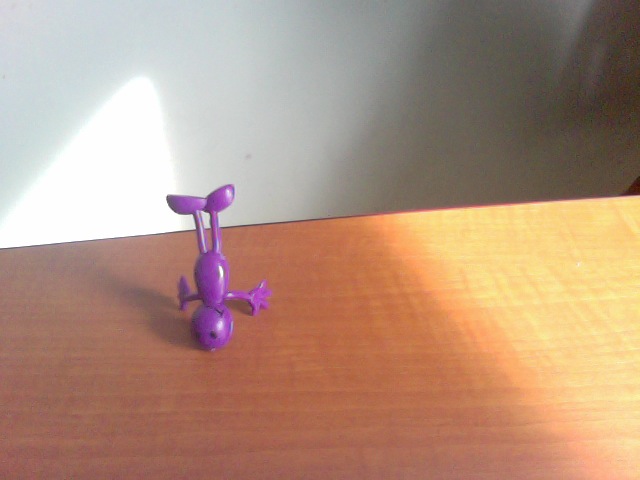
Turns out the little guys are not so good at standing up, but they do sit. They can hug each other pretty well. And they can stand on their heads.

Look ma!

Look ma!

I will have you know, this official instructional method is Testing-Coordinator-Approved. And in a week that has been a little low on excitement, my 11th graders are feeling good about the little guys. A little island of play in a big sea of multiple choice bubbles.

One way we introduce projects at SLA.

SLA Science Teacher Tim Best asked for some best practices around this question, and then SLA History Teacher Diana Laufenberg pointed out my answer could be a blog post. So here we go:

People often wonder how we go about explaining projects to our students. Obviously, with many being open-ended in both topic selection and what the final product looks like, sometimes the details are fuzzy for a reason.

After my first year working here, however, I learned to anticipate the kinds of questions kids would ask about a project —  the parameters of the subject matter, the timeline, etc.

Now, every time I do a project write-up, I follow it with a “frequently asked questions, as imagined by Ms. Pahomov” where I write questions and answer them in short paragraphs. I read this to them along w/ the general description. It helps address a lot of obvious questions, and can also be referred back to a week later, when kids have forgotten what you said.

Here’s a (long-ish) example of how I pitch the podcast project to our 10th Graders. And yes, I will post a full write-up and reflection of this project sometime soon.

Q3 BENCHMARK: “Crossing Boundaries” podcast.

Your task this quarter is to create a podcast around the theme of “crossing boundaries.” The final product is a 12-15 minute podcast which tells a true story (or series of related stories) related to this theme. You are responsible for identifying an engaging story, conducting the necessary interview/s, editing the content, and adding narration, music, and any other components that are needed.

This project is divided into two phases:

PHASE ONE is identifying the best story to share, and planning your content. In order to do this effectively, you must brainstorm SEVERAL ideas–and then get public feedback and look into how easy it will be to get the interviews you need. It is your job to settle on an idea, map out your podcast, and complete at least ONE interview by Tuesday, Feb. 21st.

PHASE TWO is the completion of your final product, which you will have several in-class work periods to complete. This time will be useless if you have not yet completed an interview–make sure you complete phase one on time!

The final podcast is due Tuesday, Feb 29th. It will be posted on our class blog — AKA you are making a product for the general public to enjoy!

Frequently Asked Questions (as imagined by Ms. Pahomov)

I really don’t have an idea for a theme.
We are going to brainstorm in class — start by looking around your own world and think about who has done something out of the ordinary. Did they flaunt a social norm, or challenge a long-standing rule or expectation, and why? It doesn’t have to be a life-or-death situation. You might find inspiration by looking at the rules from our “Boy/Girl” stories, and figure out who has ever crossed one of those boundaries.

Can I tell lots of little stories? Each of my friends has a little funny story.
Most of you will focus on ONE larger story — this is more interesting for the listener. If you have a very clever theme, you might have unrelated anecdotes from different people. But don’t have totally random stories that all relate to “crossing boundaries” in different ways — that’s just lazy.

Can the story be about myself?
Yes, but you have to have an interview with at least one other person! You could potentially record an interview/conversation with you and somebody else who was involved in the story, talking about what happened and reflecting.

I have the world’s BEST story and it’s going to be an hour long. Is that ok?
No. This is one of the time where I am going to be draconian about a limit on the project — your podcast can really not be any longer than 15 minutes. If it is longer, I will simply stop listening at the 15 minute mark, and that will make your podcast sound like it’s incomplete. Use your editing skills!

I want my grandmother to tell her life story. Ok?
No. I’m sure your grandmother is nice and all, but hearing every detail means there’s no focus. What’s the most interesting boundary she ever crossed? Is she a forgotten Rosa Parks? Did she dress like a punk when she went to church? Zoom in on a moment like that.

Starting up the 2Fer tradition.

In the last year, I have made a few presentations about using Google Docs as a venue for student essays at SLA. During those presentations, I tended to gloss over the assignment we first adapted for GDocs — which is a shame, because it deserves its own moment in the spotlight.

The original brainchild of Mr. Chase, the instructions for 2Fers currently read as follows:

A 2Fer is an analytical paper on any topic you choose. There are four basic guidelines that must be followed:

1. The 2fer has a thesis statement that is unique, insightful, and debatable. It does not re-state a commonly held belief or choose sides in a worn-out debate — it reflects an observation and conclusion you have come to on your own.

2. The 2fer uses at least two outside sources to support your thesis, and cites them correctly. This includes integrating the information seamlessly into the text of your essay, and using correct MLA citation for both the in-text citation and the works cited page.

3. The 2fer never uses the first or second person (“I” or “you.”) Instead of writing “I think that…” just write what you think!  If you quote a source where the speaker says “I” or “you,” that’s fine.

4. The 2fer proves its thesis statement through the quality of analysis and factual support, not raw force of opinion. Avoid topics where your personal feelings dominate the paper, or rely heavily on individual experiences or beliefs (the existence of an afterlife, the nature of love, etc.) Look instead for topics where there is a wealth of credible outside material you can mine for support. A well-written 2Fer doesn’t argue, it proves.

You want to write about the magazine you’re reading? Do it. The video game you’re playing? Awesome. The mysteries of SEPTA? Absolutely. Are you feeling meta today, and want to attempt the 2Fer-about-a-2Fer? A valiant endeavor, where many students have gone before (with amusing results.)

This freedom of choice is obviously a blessing and a curse. To help students narrow it down, we’ve been talking about how to come up with a viable thesis statement — which, of course, first requires that you ask the right question. See the slide deck below for a glimpse into our conversations.

A new daily tradition.

This is where I will be writing all year.

Last year, we had some hiccups with commenting on our public classroom blogs. After one class had published a round of personal reflective essays, I decided to go analog with our feedback, and we wrote notes of appreciation to each other — folded, signed, and hand-delivered.

It was an unexpectedly fabulous day in class, and did a lot to foster community. The writing was different than straight-up thank you notes; instead of showing your gratitude for something given to or done for them specifically, students were applauding something that they had simply observed. In a typing-heavy environment, writing them by hand was novel. And everybody delivering them felt a bit like an elementary school on Valentine’s day — in a good way.

Afterwards, I kicked myself for not grabbing a few cards and joining in. As an English teacher, I write tons of feedback, and never in red pen (or font) — but sometimes I feel like the moments for pure appreciation get away from me, moments of inspiration, resilience, or kindness that are observed but never mentioned. I get caught up in the grind.

So last week I ordered myself a year’s worth of notecards and envelopes. I plan on writing one note a day, every day we are in school, and then delivering it by hand. The goal is to appreciate everybody in the building at least once before the year is over. And some I will photograph and post here as well.

(In case you’re worried, I did the math: this year I teach 130 students, plus 22 advisees, plus 25+ on staff. Thank goodness the school year runs 180 days.)