Category Archives: SLA

At SLA, we like to share.

One day, during my first year of teaching at SLA, I walked into the office and announced that I had no idea what I was doing in my English class next period.

Of course, I knew what I was “doing”–I had a lesson plan written and all that–but I had no idea how I was actually going to make it work.

Zac Chase and Matt Kay were at the table, and they quickly tossed out a dozen different ideas at me. I don’t even remember what the material was, but I just remember feeling supported, and saved.

Sometimes, I forget how incredibly awesome this kind of open sharing is–and, sadly, how rare it is in many school settings. For one thing, many school administrations would have your head if you walked into the office and stated that you were pedagogically lost. So instead, people have to slink away to their classrooms and make the best of it. At least until they can find some open-minded folks to engage in the open flow of ideas.

I’ve got better footing now, but I’m still endlessly thankful for everyone who has helped and continues to help me. The good thing is that at SLA, it’s not a chore! And one of the best bits of this process sharing the accomplishments of our students.

They’re in on the game, too. Take the Digital Story “You Have Nothing to Hide From” by SLA Sophomore My Truong. She made it for an assignment in my class, and then shared it with Kay, which Lehmann saw and re-posted, and it gets retweeted by a bunch of folks, and I then wrote about it on this blog, and Meenoo Rami featured it on Ed Week Teacher — and I didn’t even create the project. The whole idea came from Josh Block, who started this assignment last year in his class.

So, if you’re joining us for EduCon this year, make sure you ask us to share some of our methods, or our projects. Or just walk into the office and announce that you’re lost. Somebody will look up and help you out.

Looking at both sides of language and power.

I wrote about reading James Baldwin and unpacking language and power with my 10th Graders earlier this month, and now I’d like to share a few of their final projects in that unit.

Here’s a snippet of the instructions:

Your language autobiography will investigate some of the themes from our language unit and relate them to your life. The expectation for this paper is a polished piece of writing that combines personal experience with larger analysis and reflection.

This is NOT a traditional “thesis paper” — you will share a deep understanding about yourself, but you want to lead your reader to that instead of sharing it in your intro paragraph.

Your paper must contain at least one descriptive scene from your own life — and this will probably include dialogue — along with deeper analysis. You must also incorporate a quote or idea from the language essays we are reading together.

If you’re familiar with the diverse makeup of our student body, you can imagine many of the relevant subjects that many of our students explore. Code switching, slang, foreign languages at home, neighborhood accents, are all topics that students often gravitate towards.

Every year, though, there are also students who hesitate when the assignment is given. They don’t see anything noteworthy or unusual about their language; they have never experienced it as a place of conflict. They might be white, or middle class, or sound like news broadcasters, or something else entirely — it all depends.

This unsureness can turn into a situation where the majority or dominant culture feels under-celebrated, like they have no unique experience. (This is, I think, where the motivation for things like “White Studies” comes from.) The privilege and power might be something to be defended, or ashamed of, instead of examined.

I am blown away every year when kids actively resist this path, and take the time to explore their individual stories. Whether they’re coming from a place of struggle or a place of comfort, each can be examined in the larger context of society. Students do a great job getting past cliche and to real meaning.

And with that, I give you two Digital Story versions of this project. Both take on this project through the lens of school — and present the opposite, but equally relevant sides of the same coin.

“You Have Nothing To Hide From”

“Listen to Our Words”

Thanks to Josh Block for handing me both the original assignment and the Digital Story remix.

EduConversation: Creating the Ethic of Care

Screen shot 2013-01-14 at 11.39.14 AM

This is the second of two EduCon sessions that I am participating in. I joined this one in a happy moment of confluence, when I was toying around with building a session around my posts about standardized testing — and then I found out that our esteemed PE and Health teacher Pia Martin had already planned one with a similar focus. And Lehmann was in on it too, so we had ourselves a party.

This all got sorted out through a series of staff meetings and casual office conversations — a nice reminder of how the easy sharing of ideas at SLA benefits us, and you!

Here’s the official write up from our EduCon page:

At SLA, the Ethic of Care is central to the way we treat our students and each other. But what does that look like in practice? As educators, how do we make sure that the students we teach come first, and not the subject? How do we create and sustain an environment where students are supported and cared for while honoring the structure necessary for a school to function?

This conversation, led by the principal and two teachers, will address the successes and challenges of implementing the Ethic of Care at every level of a school’s operations, from daily classroom interactions to the strategic design of school policies and operations. Participants will be invited to share stories from their own learning environments in order to examine how they too can “care for” instead of “care about.”

For more context about where I’m coming from in this, check out my posts on “love in the face of the system.” Too often, teachers caring for students only happens in the gaps between the curriculum and the rules. I look forward to brainstorming with participants about how that compassion can be embedded in the coursework itself.

I would tell you to register, but the conference is sold out! However, all sessions will be streaming online, so we encourage you to join us from your nearest internet connection.

Unit Plan: Independent Reading

Reading slide

After spending a month or so on Shakespeare, it’s time to set 11th Graders free with their reading. This unit is self-explanatory in its title, but the focus changes a bit each time.

Here are the essential questions for the unit:

  • What are my reading preferences, and what influenced these preferences?
  • How do I change as a reader when I read different books?
  • How can reading make me happy?

The unit also seeks to answer one of the three grade-wide essential questions, around the theme of change:

What causes systematic and individual change?

This unit really seeks to acknowledge that students are in very different places with both their attitudes and skills. The goal is to help them figure out where they’re at, meet them there, and help them improve.

When they arrive on the first day, students are met with the journal prompt displayed at the top of this page: What’s the last book you truly enjoyed reading? Why?

This leads into my slideshow of the Reluctant Readers Bill of Rights — which I believe is a must-share for any independent reading unit — and some discussion of my own current reading habits. Extra credit points in my heart go to any student who notices that one of those books is not in English.


Lastly, I introduce them to the idea of their “Reading Happy Place.” Is it a place? A time of day? A noise level? A state of mind? Sometimes we draw visualizations of what that place looks or feels like.

Students don’t always buy what I’m selling, at least not right away. Especially that part where the bill of rights says you have the right not to read. “What’s the catch?” They ask. “When are you going to make us do something?”

The beauty is that there is no catch. As long as they are reading and loving it, they’re doing the right thing. And if they’re not loving it, then it’s on them to find the time and place and book that inspires them.

Check out the complete unit here. I will also be writing up some activities and assessments from this unit in the coming weeks.

An EduConversation about Standards Based Grading.

Screen shot 2013-01-14 at 11.39.14 AM

When it was time for SLA teachers to brainstorm sessions for this year’s EduCon, Standards Based Grading was a no-brainer.

SLA faculty has been building, tweaking, tearing down, testing, implementing, arguing, and also agreeing about standards for 2+ years now. As with many things at SLA, people sometimes assume, looking at us at a distance, that we’re an educational utopia and the learning here just magically happens. We will be happy to disabuse you of that notion, and give you perspective on what building your own standards-based grading system involves, and how we integrated that with project based learning. To give you a full sense of that picture, we have a representative from each major discipline — and we all came to standards from a very different place:

  • Mark Bey – Spanish
  • Roz Echols – Physics
  • Pearl Jonas – History (and a first-year SLA teacher!)
  • Brad Latimer – Math
  • Larissa Pahomov – English

Here’s our official write-up:

In the face of Common Core and increasing pressure from administrations, many schools are looking to produce more data about student learning. At SLA, teachers have responded to this shift by creating their own system of Standards Based Reporting. In this panel conversation, teachers from each discipline will discuss how they created standards language for their specific subject area, how they track student progress throughout the school year, and how they integrate the skills and reflection into their own classroom. The staff will also share the online system SLA uses to collect and report standards data with students.

If you have any questions or ideas in advance, we strongly encourage you to post them as a comment on our EduCon page — that way we can take it into consideration as we build our framework for the session.

How to collaborate on a test.

At SLA, the 11th Graders take vocabulary tests every two weeks. The process is as cut and dry as you could imagine — a list of 20 words, taken from The Princeton Review’s “1000 most common SAT vocabulary words,” and they’re tested on ten at random, where they have to write the word and a synonym, antonym, or sentence for each one.

This is the only formal testing I do in my classroom, and I like to think it helps prep them a bit for the actual SAT, not to mention the Keystone exams. I’m probably stating the obvious for folks that don’t work in a project based environment.

But once in a while, I like to mix things up.

Today, I read them ten words, and then each table of four students produced one final document: ten words spelled correctly, and one sentence for each word showing its meaning in context.

Their faces light up when I explain the procedure. A couple of them because, yeah, they didn’t study enough and they’re relieved. But most of them are excited because they like collaborating. They huddle over the papers, speaking quietly so the other tables can’t hear them, and tease out what the best use of each word would be.

This is, of course, what I really want — students talking about words, making as many touch points as possible in the hopes that the word will stick after testing day. Collaborative tests don’t give me a snapshot of individual knowledge in that moment, but they do give me hope that the knowledge will last beyond the day of the exam.

When we do individual quizzes, we review them right after as a class, which gives us time to talk about the words. But I know that the content is better coming from their peers than from me. And after a few weeks of practice standardized testing in solitude, I’m happy to give them something to do together.

So, how could you turn one of your tests into a collaborative affair?

Cover it up.


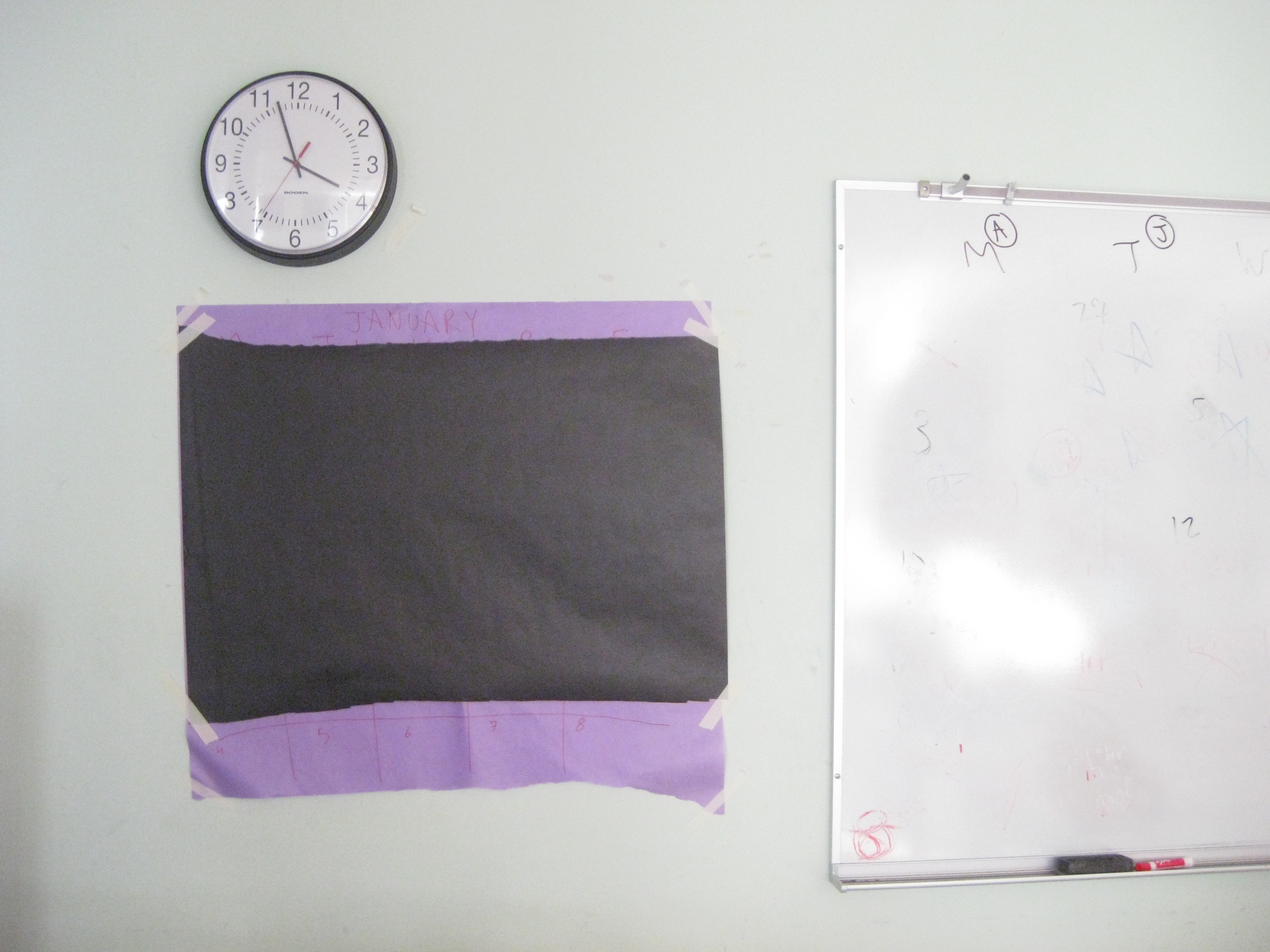
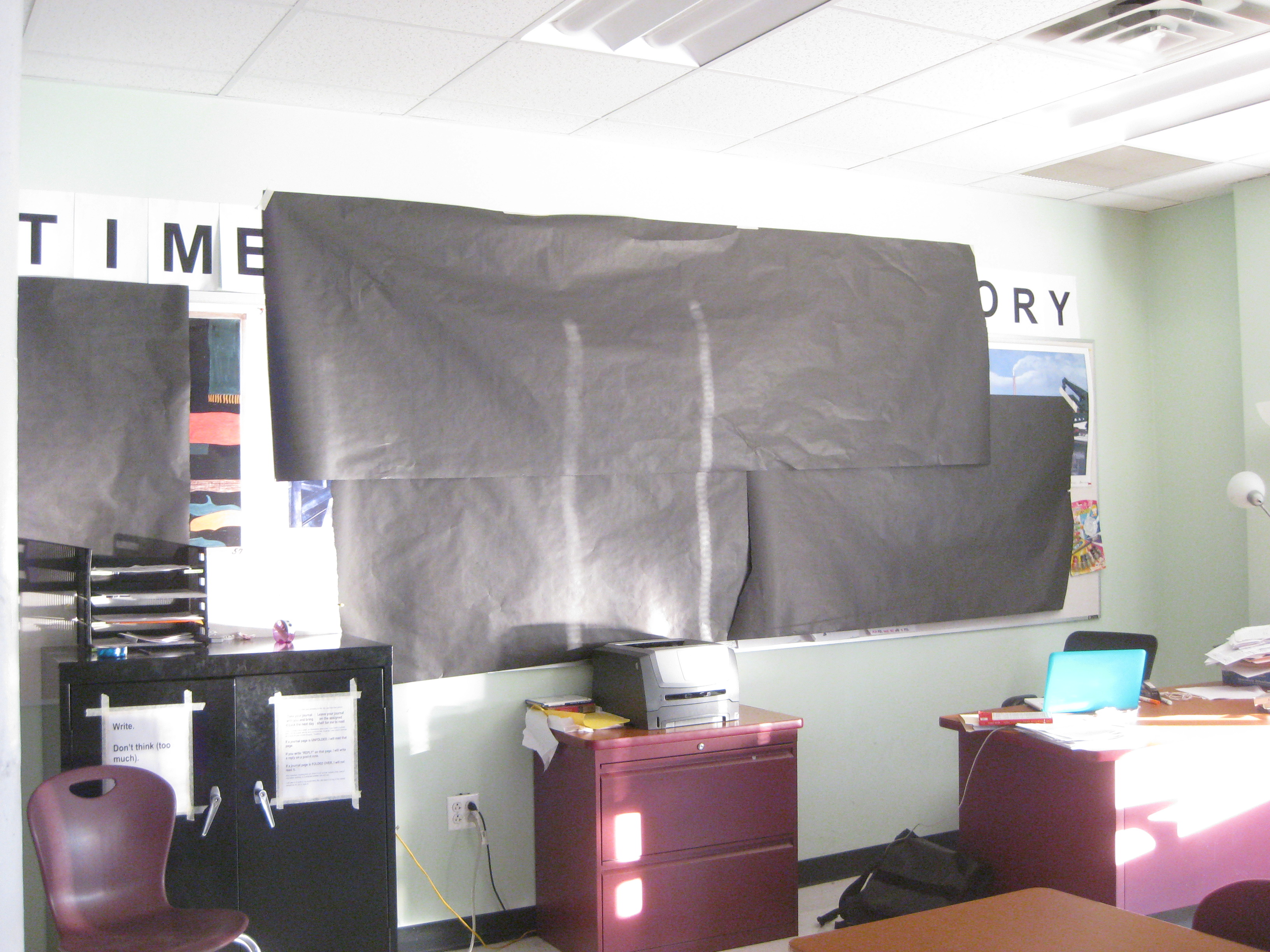
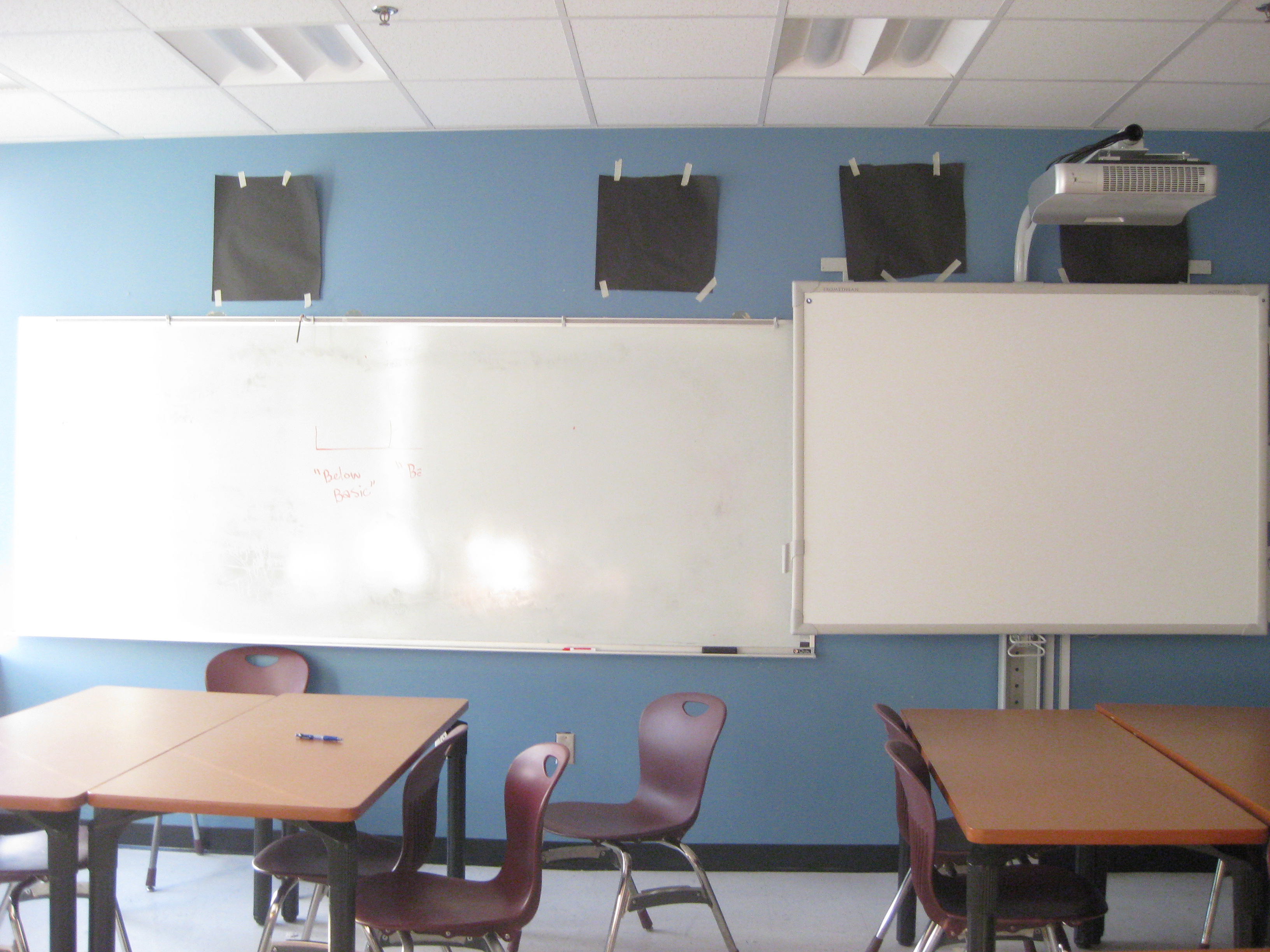
It’s that time of year again. The time where we get out the black paper and cover up any material which could be seen as helpful on the state standardized exams.

IMG_2362


We follow the rules around here. And I’m on board, obviously. So today during advisory, we measured and cut and stood on chairs and taped.

IMG_2363

I just hate that my room has to look like a funeral as a result. Death to the learning.

IMG_2364

Good thing it’s only temporary.

Truth and Storytelling: Two Final Essays

My example of a journal brainstorm: "Draw the relationship between the self and the changing world."

My example of a journal brainstorm: “Draw the relationship between the self and the changing world.”

I started this series two months ago, but here’s the final project that goes with the Things They Carried: Truth and Storytelling Unit.

Your benchmark task is to answer the essential question:

What is the relationship between the self and the changing world?

(Sub questions: How does the self react to and deal with change? How does the world in turn react when a person changes? How does this cycle work? What is notable about it?)

You will do this by writing an essay that is both analytical and narrative.

The analytical portion of you essay will identify a major lesson O’Brien gives us about the self in the changing world. You must analyze how he conveys this message in his book. Once this formal analysis is complete, you must then apply your understanding from the book it to your own beliefs and experiences, and then write a personal essay around that theme. (This section can resemble one of the stories in the book.)

The analytical section really just reinforces the writing skills we’ve been working on all quarter with the 2Fers — and students see this. The narrative assignment, though, really blows things wide open. I emphasize that, while you can focus on death or trauma (and many students do), there are so many lessons embedded in the book about the self in the face of x y or z change. I also rely on lessons from Peter Elbow to get these ideas really flowing from students — not always easy after a few months of mostly analytical composition.

Students write about the acute anxiety of transferring schools, or refusing to watch a loved one die in the hospital; to be intensely attached to every item in a care package sent to summer camp, or to have an anger that they bank down inside them, only to have it seep out at unexpected moments.

I love this project, and it’s a fitting end to a unit where we have explored the purpose of storytelling in their lives. (At this point they usually get over the fact that Tim O’Brien was “lying” with his book of fiction.)

How to prevent testing fatigue.

It’s simple: don’t test too much.

Seriously though. That doesn’t mean that you don’t prep. It just means that you get creative. I’ve written about lots of these tactics before:

Attack sample questions as a class. Teach them the structure behind the different types of questions. Send them on scavenger hunts in pairs. Have them write questions on their own.Let them be frustrated, and don’t forget to tell them that you love them.

The last thing you want to do is hit them on the head with multiple choice practice tests, day after day after day. It’s the educational equivalent of the assembly line. At some point, people get so bored that they quit. And you don’t want that to happen before the actual testing happens.

When kids start to say, “this is dumb,” I replace that with: “No, this is easy.” This is my adult equivalent of “it’s not that deep.” And I mean it.

Throwing students off the deep end.

My experience as a high school student of English often consisted of being given complicated material, being told it was Very Important or A Part of The Canon, and muddling through it as best I could, with some vague notion that this experience would mean something later.

On the whole, I find this approach silly. It was too much of the now-you-will-sound-cultured-at-cocktail-parties mindset.

However, there were a bunch a moments when, upon entering college or “real life,” that the lightbulb went off in my brain: so that’s what they were talking about. Tough literature seemed less daunting after having slogged through “Absalom, Absalom!” my senior year of high school.

It is with this in mind that I occasionally throw my students something that will take a maximum amount of effort to unpack. For example, take the very first paragraph of James Baldwin’s “If Black English Isn’t a Language, Then Tell Me, What Is?”

The argument concerning the use, or the status, or the reality, of black English is rooted in American history and has absolutely nothing to do with the question the argument supposes itself to be posing. The argument has nothing to do with language itself but with the role of language. Language, incontestably, reveals the speaker. Language, also, far more dubiously, is meant to define the other–and, in this case, the other is refusing to be defined by a language that has never been able to recognize him.

We read it twice. We talk about what the original argument is, and theorize as to what Baldwin’s trouble with it must be. We define “incontestably” and “dubiously,” We discuss the academic meaning of “the other.” We talk about who that other is, and what reasons “he” might have for refusing to be defined by it. This takes a while. It’s not easy work.

As the reading continues, we pull from African American History class in 9th grade, we pull from our geographical knowledge (quick, who knows where Martinique is? Or the where the Basque live?) I ask them if they know why Malcolm Little chose “X” as his last name. Somebody explains that. We get to this line:

To open your mouth in England is (if I may use black English) to “put your business in the street”: You have confessed your parents, your youth, your school, your salary, your self-esteem, and, alas, your future.

Who knows something about British Accents? Who talked to the exchange students from Liverpool when they were here last year? Next time, ask them about how they sound different from Londoners; you’ll get an earful. Maybe we put “ask” on the board, and see whether people pronounce it “ask” or “axe.” We talk about that, too.

We hack our way through the whole thing, and by the end we’ve gone in a dozen different interesting directions regarding language, identity, and power. Great set-up for a benchmark essay. Throwing students off the deep end is okay, as long as you jump in with them.

And then, to cap off the class, I show them the goofiest photo of James Baldwin I can find.

97d/03/huch/5086/38